
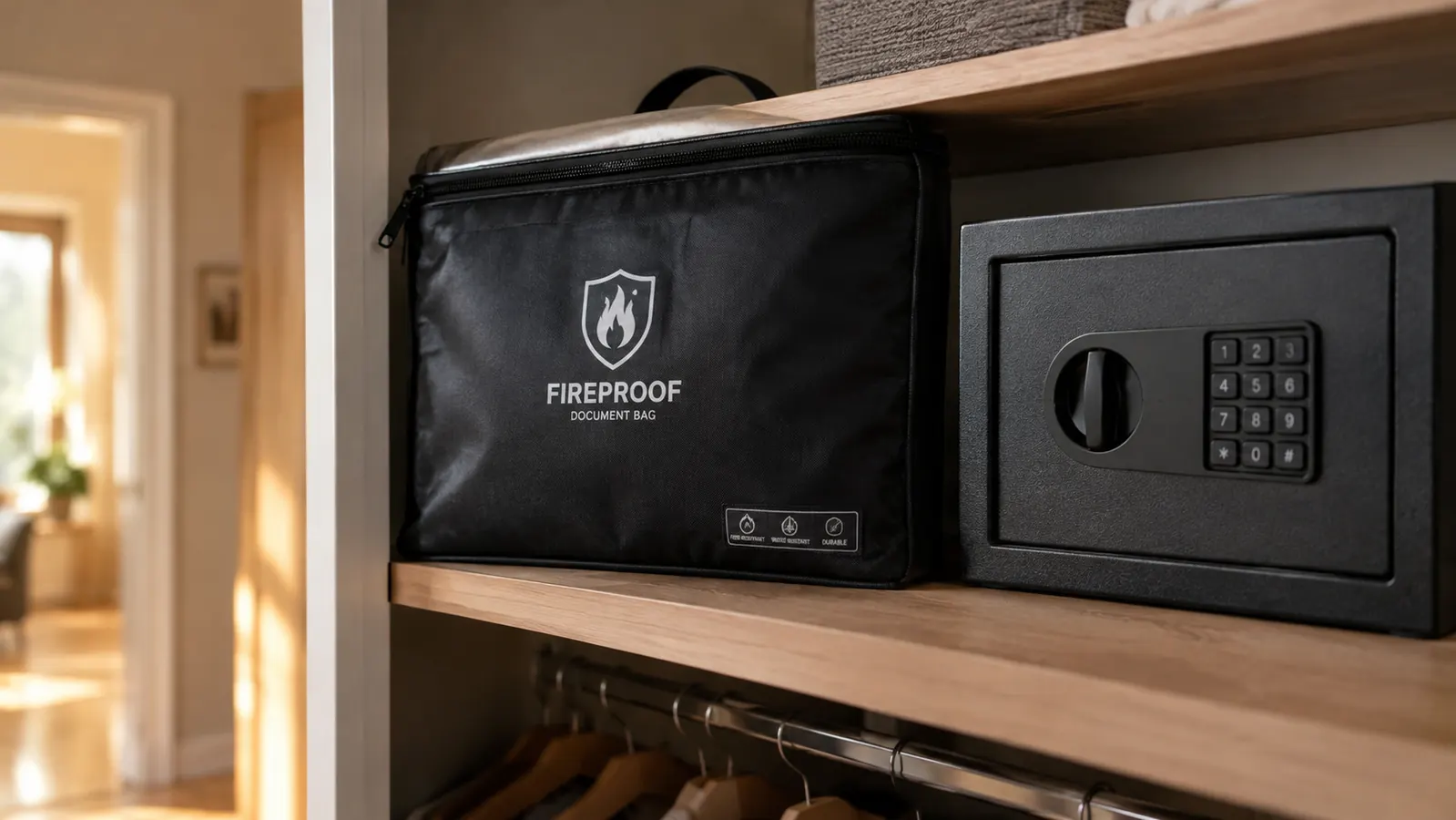
After 25 years of walking through houses after the fire trucks left, I can tell you almost exactly where the homeowners kept their paperwork. It was in the top drawer of the kitchen desk. Or the nightstand. Or a shoebox on the top shelf of the closet. And in the houses that burned, that paperwork was usually gone. That is why, when I retired and started testing products for this site, the Andyer fireproof document bag was one of the first things I wanted to look at honestly. Not as a marketing sheet, but as someone who has seen what actually survives a house fire.
I am Theresa Valdez. I spent about 25 years as a homeowners-insurance claims adjuster in Albuquerque, New Mexico, and I now test home protection products from the point of view of someone who has seen the damage. This review is the honest version. I bought the Andyer 2 Pockets Fireproof Document Bag about a year ago, and I have been using it every day since. Here is what I think you should know before you buy one, including the parts the listing does not emphasize.
The Quick Verdict
The Andyer fireproof document bag is a genuinely useful grab-and-go copy kit, not a replacement for a real safe. Buy it for what it is and you will be glad you did.
Amazon Check Today's Price →The honest version: this bag is a smart second layer, not a safe substitute
I keep mine beside the closet safe, packed with copies of the documents that would be a nightmare to replace. It is the bag I would grab on the way out the door.
Amazon Check Today's Price on Amazon →How I Tested It, Honestly
I did not set my house on fire to test this bag, and I want to be upfront about that. What I did do was use it daily for a year, pack it the way I would actually pack it, and then run a few practical tests that matter to me: how it holds up to being grabbed quickly, how it handles a full load, and how the zippers and seams look after twelve months of regular use.
The bag arrived on a Wednesday in early October, and my first instinct was to pack it the way I used to pack a file drawer: everything I could possibly need, originals included. That failed within an hour. The bag was too heavy to lift with one hand, the zippers strained, and I realized I had built a second safe instead of a grab bag. So I emptied it and started over with a rule I should have known from the start: copies go in the bag, originals stay in the bolted-down safe.
Once I had the right contents, I ran the test that actually matters. I set the kitchen timer for sixty seconds, put my phone in my pocket, and walked through the drill: open the hall closet, lift the bag off the shelf, and get to the front door. The first time took about forty seconds, and that included me fumbling with the closet light. The bag did its job. It came off the shelf cleanly, the handles held a full load, and nothing shifted around inside.
I also did something adjusters do naturally: I thought about the worst-case scenarios I have actually seen. A kitchen fire that starts in the wall. A break-in where the thief empties the nightstand drawer. A water heater that bursts and soaks the bottom shelf of the closet. I packed the bag for those scenarios, not for the marketing photos.
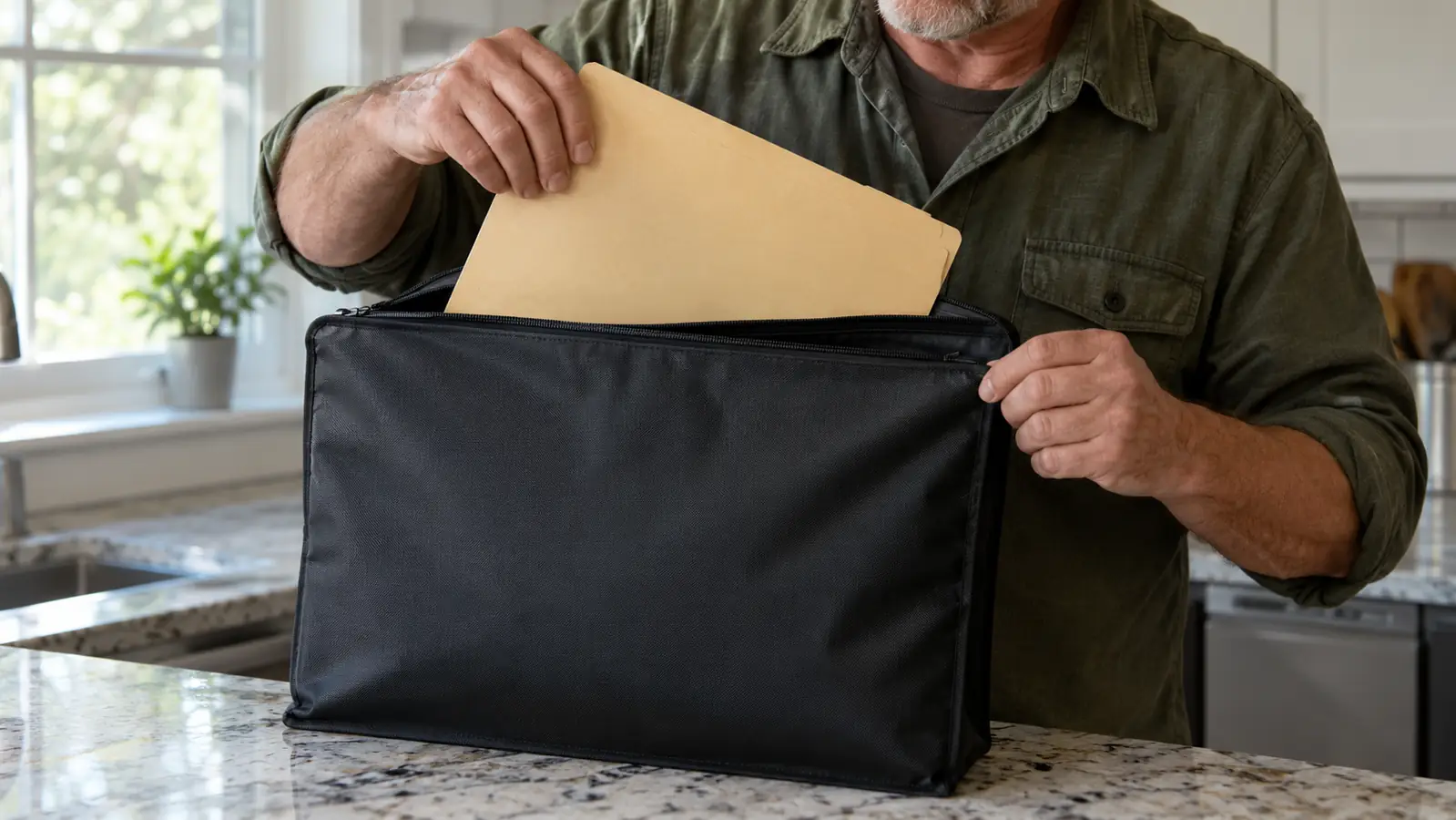
The bag has two main pockets and a few smaller organizer slots. I use the front pocket for copies of our IDs and the back pocket for printed copies of insurance policies. The small slots hold a USB drive with scanned family photos, a list of account numbers, and some emergency cash in small bills. That is the kit I would grab if we had to leave in a hurry.
In June, about eight months in, I went through the bag the way I used to inspect a roof after a hailstorm. I checked every seam, every zipper tooth, and every corner where the fabric folds. The only thing I found was a loose thread on the inside of the back pocket, which I snipped off. For a bag that gets opened at least once a day, that is a good report.
What the Andyer Bag Does Well
The first thing I noticed is that the Andyer bag is genuinely easy to grab. It has sturdy handles and a shape that fits under your arm or in a tote. When I tested pulling it off the shelf with one hand while holding a phone in the other, it worked. That sounds like a small thing, but in the moment of an actual emergency, it is the whole point. At roughly 15 by 11 inches, it is smaller than a breadbox and light enough that I forget it is on my arm until I need it.
The second thing is organization. The two pockets mean I do not have to dig through a pile of papers to find the passport. The clear organizer slots let me see what is inside without unzipping everything. For someone like me who likes order, that is a real quality-of-life improvement over the old lockbox, where everything sat in one jumbled pile. On a normal Tuesday morning, grabbing the bag and confirming the passports are in the front pocket takes me about ten seconds.
The third thing is the fire-resistant material itself. The outer layer is a silicone-coated fiberglass fabric, and the listing describes it as able to withstand high heat. I have not set it on fire, and I will not pretend I did. What I can tell you is that the material feels substantial, the stitching is solid, and after a year of being handled, zipped, unzipped, and moved around, it shows almost no wear. The zippers still run smoothly, and the seams have not pulled anywhere, even in the corners where I tend to overload the pockets.
One detail I did not expect to appreciate: the bag lies flat. The old lockbox was a cube, so it wasted space on the shelf and collected dust on top. The Andyer bag stands upright against the side of the closet, takes up almost no room, and does not look like a target. If a thief glances into the closet, a fabric bag on a shelf is a lot less interesting than a metal box that screams 'valuables inside.'
It also travels well. In March we drove to Phoenix to see our older daughter, and the bag came along in the back seat. It fit flat in the bottom of a duffel bag, and at the hotel I pulled it out and put it in the room safe with our passports and the cash. On the way home it rode under the seat, where I could reach it without stopping. A metal lockbox would have been dead weight in that duffel.
The Part Nobody Tells You
Here is the honest part. A fireproof document bag is not a fireproof safe. It is a bag made of fire-resistant material, and it will protect its contents from heat and flames for a limited time. It will not survive being in the center of a fully involved house fire for hours. No portable bag will. If you are expecting the Andyer bag to protect your documents through a total house fire the way a bolted-down rated safe might, you will be disappointed.
A fireproof bag will buy you time, not immortality. In a real house fire, minutes matter, and the bag's job is to get your most important papers through the worst of it, not to survive being the fuel.
I saw what a fully involved fire does to a house in 2019, on a claim in the Northeast Heights. The fire started in the garage and burned for close to an hour before the department could get water on it. The living room was gone. The kitchen was gone. In the back bedroom, a metal file box under the desk had survived, but the papers inside were scorched at the edges and wet from the hoses. That is the reality. Fire is not a gentle test. It is heat, smoke, and water all at once, and anything you want to keep has to survive all three.
The same goes for water. The bag is not advertised as waterproof, and after a year of use I would not trust it to keep documents dry if it sat in standing water. I keep mine on a shelf, not on the floor, and I would advise you to do the same. The listing is honest about this, but a lot of reviews you will read online are not. A burst water heater or a fire hose will soak anything at floor level, and no amount of fire-resistant fabric changes that.
There is also the question of what 'fireproof' means in the listing. It means the material resists heat and flame for a period of time, not that the contents are guaranteed. I have seen too many people buy a fireproof box, put their only copy of the deed inside, and assume the problem is solved. The problem is never solved by one layer. It is solved by copies, by a rated safe, and by keeping the most important originals somewhere they are not in the same building as the fire.
One more thing the reviews tend to skip: the bag does nothing about theft. It has no lock, and a determined person can open a zipper in seconds. I saw a claim in 2017 where a thief walked out with a fireproof document bag that was sitting on a closet shelf in plain view, because the homeowner had left the house for the afternoon. The bag protected the papers from fire, but it did not protect them from being carried away. That is why mine holds copies, not originals, and why the originals live in the bolted-down safe.
How It Compares to What I Used Before
Before I started testing products for this site, I kept our important papers in a plain metal lockbox in the closet. It was what most people have: a box that keeps things organized but does nothing against fire or water. The Andyer bag is a meaningful step up from that, because it at least gives the contents a chance in a fire. It is also a step up in everyday use, because the pockets and slots beat a single jumbled compartment in every way that matters on a normal day.
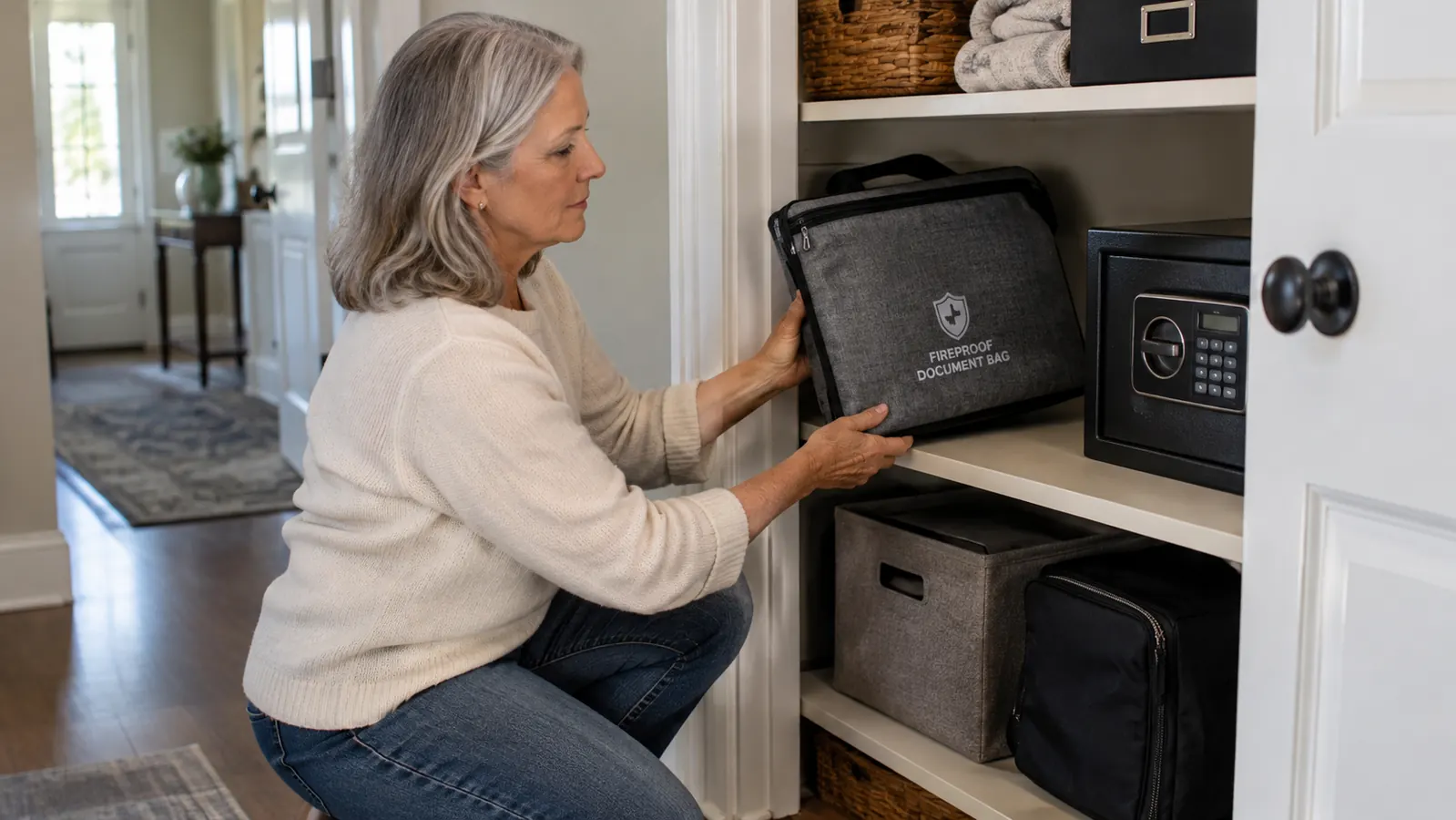
About two years ago, I bought a SentrySafe 1-hour fireproof digital keypad safe and bolted it to the floor of the hall closet. That is where the deed, the titles, the passports, the policies, some cash, and the backup drive live now. The Andyer bag sits on the shelf right beside that safe, holding copies. That combination, a real safe for the originals and a grab-and-go bag for copies, is the setup I would recommend to anyone who asks.
The division of labor took me a while to settle on. At first I tried to keep the originals in the bag, because the bag was easier to reach. Then I remembered every claim I ever worked where the safe was open when the fire started, or where the documents were scattered across the kitchen table. The bag is for the copies you can replace, and the safe is for the originals you cannot. Once I stopped fighting that logic, the system got simple.
The bag is not a replacement for the safe, and I want to be clear about that. It is the second layer. The layer you grab when the alarm goes off and you have thirty seconds to leave.
What I Keep in Mine
After a year of refining, here is exactly what is in my Andyer bag right now: copies of both our driver's licenses, copies of our passports, printed copies of our homeowners and auto insurance policies, a list of account numbers at the bank, a USB drive with scanned family photos, and emergency cash in small bills. The original documents stay in the SentrySafe.
The list changed twice in the first month. The first version included the house deed, and I took it out when I realized the original belongs in the safe and a copy from the county clerk's office is just as useful for most purposes. The second version included a list of passwords, and I took that out too, because a paper list of passwords in a bag that leaves the house is a risk I do not need. What stayed is what I would actually need in the first 48 hours after a loss.
That mix is the result of twenty-five years of seeing what people wish they had saved. The license and passport copies make replacing the originals faster. The insurance policy copies mean you can start the claims process the next morning instead of waiting for the company to mail you a new one. The cash covers a hotel room and meals for a few days. The photos are the thing people mention most often when they talk about what they lost, so I keep a backup off-site.
I check the bag every few months, usually when the clocks change. I replace the cash with fresh bills, confirm the IDs have not expired, and swap the USB drive for a newer backup. It takes about fifteen minutes, and it is the difference between a bag you trust and a bag you hope is still right. Ray jokes that I treat it like a fire drill for paperwork, and he is not wrong.
I have actually grabbed it once for real. In February, the smoke alarm went off while Ray was broiling fish, and for about thirty seconds we both thought it was a kitchen fire. I was at the hall closet with the bag in my hand before I realized it was just smoke from the broiler. That moment told me more than any test: the bag went where my hand went, without thinking. That is the entire point of a grab-and-go kit.
Who This Is For
This bag is for people who want a practical, inexpensive way to keep copies of important documents ready to grab in an emergency. It is for renters who do not want to bolt a safe to the floor. It is for people who travel and want a fire-resistant way to carry passports and itineraries. It is for anyone who has ever looked at a shoebox of important papers and thought, there has to be a better system. If you already own a safe, the bag is the natural next layer. If you do not own a safe yet, the bag is a reasonable first step while you save up for the real thing, as long as you understand the difference.
Who Should Skip It
Skip the Andyer bag if you are looking for a fireproof safe that will protect originals through a worst-case house fire. Skip it if you need a waterproof container. Skip it if you want something bolted down and immovable. For those jobs, buy a rated fireproof safe and install it properly. The bag is a complement to that, not a substitute for it. And if you are the kind of person who will buy the bag and then never update the contents, a safe with a yearly calendar reminder might serve you better. The bag only helps if it stays current.
What I Liked
- Genuinely easy to grab in a hurry, which is the whole point of a go-bag
- Two pockets and organizer slots keep documents sorted and visible
- Fire-resistant silicone-coated fiberglass material feels substantial and well made
- Inexpensive enough to buy one for the house and one for the car
- Stitching and zippers have held up well through a year of daily handling
Where It Falls Short
- Not waterproof, so it must be kept off the floor and away from standing water
- Limited fire protection compared to a bolted-down rated safe
- No lock, so it protects against fire but not theft
- The fire rating is not the kind of certified rating you get with a real safe
My honest bottom line: worth having, if you know what it is
I have owned the Andyer bag for a year and I still reach for it every time we leave town. It is the copy kit, the grab-and-go layer, and it does that job very well.
Amazon Check Today's Price on Amazon →