For twenty-five years I walked through people's homes after the worst days of their lives. I saw the closet shelf where the jewelry box used to sit, the empty spot in the bedroom where the lockbox had been carried off, the drawer that had been dumped on the floor. One house I will never forget had a beautiful antique safe in the study, solid steel, three hundred pounds, and the homeowners had left the key in the lock. The burglar opened it like a cabinet. What I learned is that most of us keep our valuables in the first place a burglar checks, or we buy a safe and then undo it with one small mistake. When I retired, I decided my own house would not be one of those stories. That is why, eight months ago, I bought the Grimtron biometric safe for the things I reach for often, and I have been testing it every day since.
I am Theresa Valdez, a retired homeowners-insurance claims adjuster in Albuquerque, New Mexico. My husband Ray and I live in a single-story ranch house, and after years of seeing what survives a break-in, I keep my mother's jewelry and a few everyday valuables in a Grimtron fingerprint safe on the shelf of our bedroom closet. This review covers what it has been like to live with that safe for eight months: the fingerprint reader, the PIN backup, the mounting, and the honest limits of what a 20-pound safe can do.
The Quick Verdict
A fast, dependable fingerprint safe for everyday valuables, as long as you bolt it down and keep the PIN backup programmed. It will not stop a determined thief with tools, but it will stop the grab-and-go search that causes most losses.
Amazon Check Today's Price →Fingerprint access in under a second, for the things you reach for daily
After eight months of daily use, the Grimtron biometric safe is the one I open most often. It sits on the bedroom closet shelf, and the fingerprint reader has yet to leave me standing in front of a locked door.
Amazon Check Today's Price on Amazon →How I've Used It
I bought the Grimtron safe last January for a specific job. My late mother's jewelry was living in a plain metal lockbox in the hall closet, the same kind of box I had seen carried out of hundreds of homes. The lockbox had a key, and the key lived in a kitchen drawer, which meant the box was about as secure as the drawer. I wanted something faster than a keypad for the pieces I wear often, and I wanted it close to where I dress in the morning. I looked at keypad safes first, but I kept picturing myself at seven in the morning, half awake, trying to remember a code. The fingerprint model cost more, but the trade felt worth it.
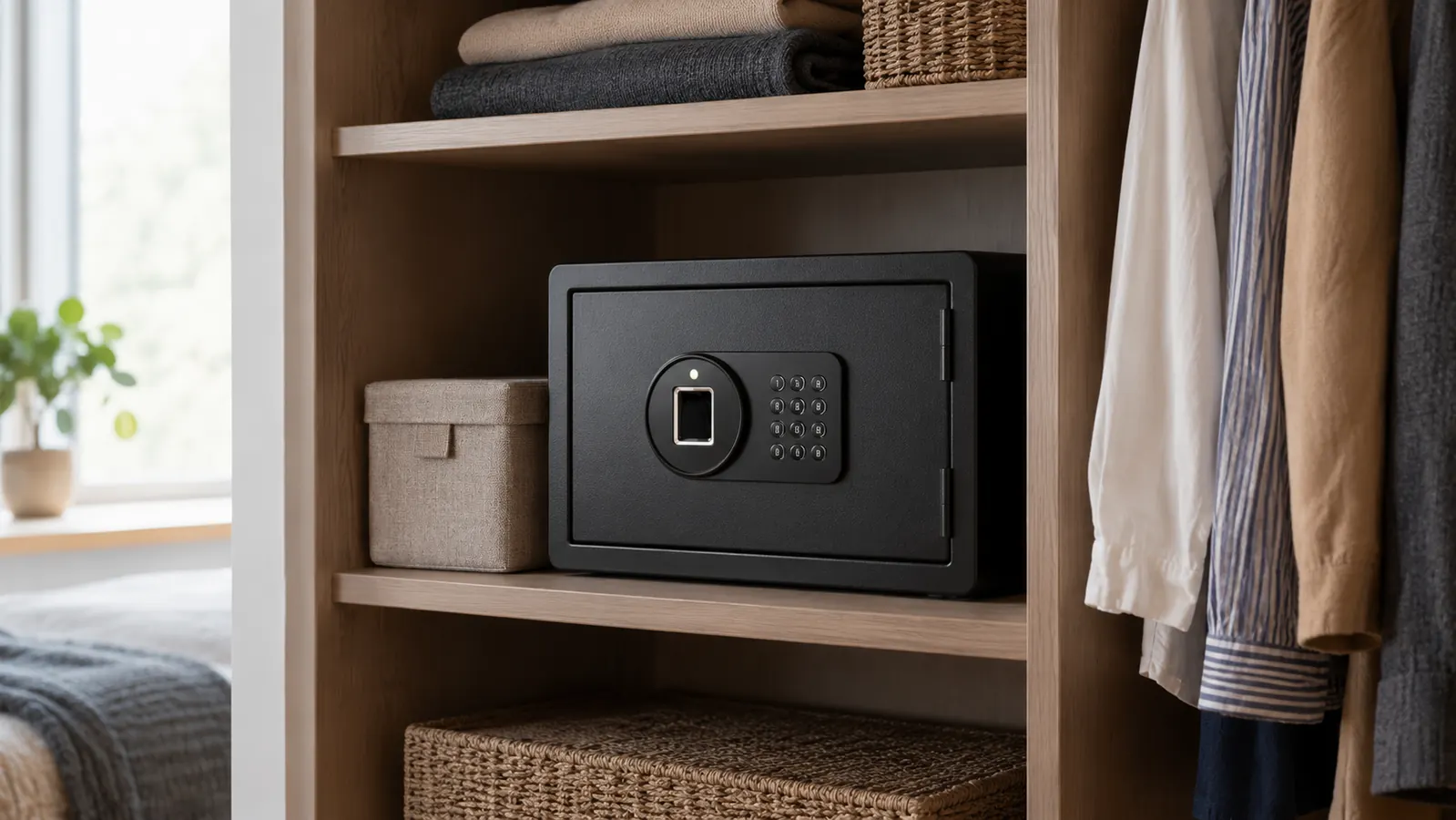
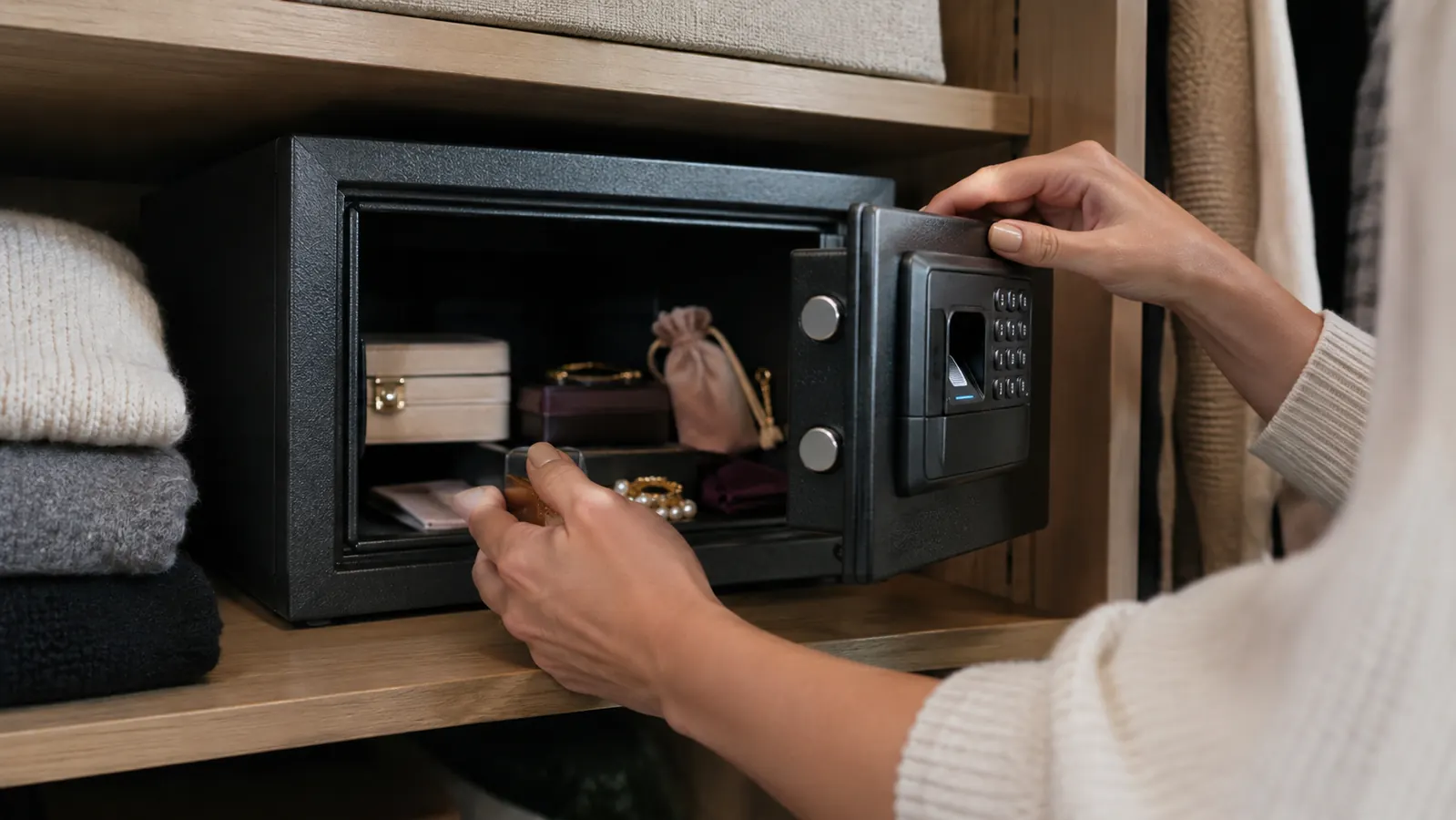
The safe now sits on the shelf of our bedroom closet, at chest height, about 54 inches off the floor, bolted to the shelf with the hardware that came in the box. The shelf is solid pine, an inch and a quarter thick, so the bolts have real wood to bite into. I chose the shelf over the floor because I did not want to bend down twice a day, and over the top of the dresser because I did not want the safe to be the first thing you see when the door opens. In it I keep my mother's jewelry, a few pieces of my own, and the small items I would rather not leave in a drawer, and everything fits without crowding. I open it most mornings to put on earrings and most evenings to take them off, which means the fingerprint reader has had a workout.
I also tested the PIN backup deliberately. The safe accepts a 3 to 8 digit code, and I programmed a 6 digit one the day I set it up. The first test was the day after: I closed the door, waited for the lock to engage, and then forced myself to use only the keypad for a full week. I wanted to know the backup worked before I needed it, not after. I have used the keypad maybe a dozen times since, mostly to confirm it still works. The one real failure happened in March, when my hands were wet from washing dishes and the reader did not recognize my print on the first try. I dried my hands, tried again, and it opened. But I used the PIN that day anyway, just to keep the habit fresh.
What the Fingerprint Reader Is Actually Like Day to Day
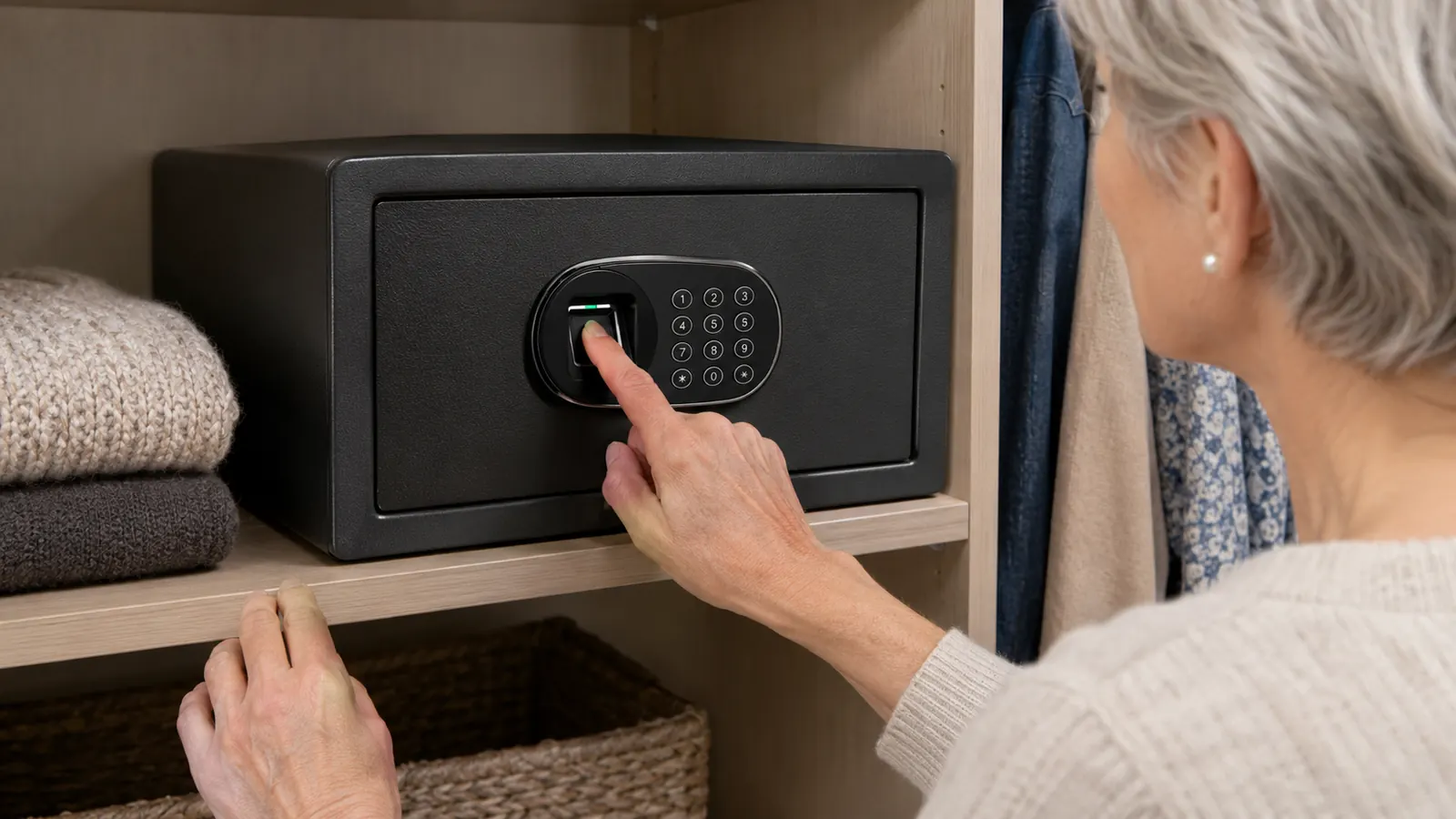
The headline feature of the Grimtron is the fingerprint pad, and it is the reason I chose this safe over a keypad model. In practice, the reader recognizes my right index finger almost instantly, usually within about a second. I have timed it with the clock on the nightstand a few times, mostly out of curiosity, and from pressing my finger to the click it is usually under two seconds. The pad sits in a spot where my finger lands on it naturally when I reach for the door, so I do not have to hunt for the sensor. The safe opens with a soft click and the door swings free. On a typical morning I am holding a coffee mug in my left hand and pressing my right index finger to the pad, and the door is open before I have finished the motion. It has become so routine that I sometimes forget I am operating a lock at all.
There are honest limits. The reader works best with a clean, dry finger. After gardening, after washing dishes, or when my hands are dusty from the garage, the first attempt sometimes fails. In February, after I had been pruning the rose bushes, I had to try twice. In April, after a day of packing boxes in the garage, my thumb failed twice before my index finger worked. The safe holds up to 20 fingerprints, so I registered both of my index fingers and both thumbs, which gives me options. I registered the right index first, then added the left index, then both thumbs, one at a time over the first week. Ray has his prints registered too, so either of us can get in without remembering a code.
The one thing I would warn anyone about: if you rely on the fingerprint alone, you are one injured finger away from being locked out. In May I caught a paper cut on the pad of my right index finger while sorting mail. For three days the reader hesitated on that finger every single time, and my left index finger worked on the first try every time. That week convinced me the backup code is not optional. A paper cut is enough to make the reader hesitate, and that is not a flaw in the Grimtron, it is the nature of optical sensors. It is exactly why the PIN backup matters. Program it on day one and test it once a month.
In eight months of near-daily use, the fingerprint reader has opened the safe on the first try the vast majority of the time. The few failures were all the same kind: a wet or dusty finger, solved in seconds by the PIN pad.
Build Quality and the 20-Pound Question
The Grimtron is a 20-pound safe, and that weight tells you most of what you need to know about its job. I carried it from the front door to the bedroom myself the day it arrived, and I was glad the walk was short. Twenty pounds is light enough to move around but heavy enough that you notice it. The steel body and the door are substantial for the price class, the hinges have not loosened in eight months, and the locking bolts still line up cleanly every time. The door is the heaviest part, and it swings on hinges that have not developed any play. It is not a bank vault and it is not a gun safe. It is a deterrent, and an effective one for the most common kind of loss.
Here is what twenty-five years of claims taught me: most break-ins are quick, noisy, and opportunistic. A burglar wants to be inside for under ten minutes. They check the master bedroom first, then the home office, then the obvious closets. They grab what is easy and they leave. I remember a claim in the Northeast Heights where the homeowners had a nice jewelry box on the dresser and a locked file cabinet in the office. The burglar took the jewelry box and never touched the file cabinet. The file cabinet was not even locked well, it just looked like work. That is the whole argument for a safe that looks like a safe. A bolted-down 20-pound steel safe does not look easy, and that alone sends most of them to the next room.
The caveat is the one I give to every friend who asks about safes: a determined thief with a pry bar, a grinder, or time can get into almost anything under a few hundred pounds. The Grimtron will not survive a sustained attack, and no honest review should pretend otherwise. I check the alignment every couple of months by closing the door slowly and watching the bolts seat, and eight months in they still line up cleanly. What it will do is survive the grab-and-go search that causes most household losses, and it will do it while keeping your everyday valuables genuinely convenient to reach.
Mounting It: Do Not Skip This Step
The single most important piece of advice I can give about this safe is to bolt it down. The Grimtron has pre-drilled holes in the bottom and the back, and the box includes the mounting hardware. Ray and I did the job on a Saturday morning in January, the same week the safe arrived. I emptied the shelf, he held the safe in place while I marked the holes with a pencil, and then I drilled pilot holes so the bolts would not split the wood. The whole job took about fifteen minutes, and most of that was me double-checking that the safe sat level. I bolted mine to the closet shelf from underneath, and it has not moved a quarter of an inch since.
Here is the reasoning from someone who has written the police reports: an unsecured 20-pound safe is a carry-out item. A burglar who finds it can tuck it under one arm and sort through it at home, where they have all the time in the world. They do not even need to open it at the house. They take it, they leave, and they work on it somewhere else. A safe that is bolted to a shelf or the floor changes the math entirely. It turns a quick grab into a project, and projects are what burglars avoid. In the claims I handled, the houses that lost the most were never the ones with the most valuables. They were the ones where the valuables were the easiest to reach. I have written the aftermath of that crime more times than I can count, and the pattern never changes.
If you rent or cannot drill into your home, consider a security cable as a minimum. It is not as good as a bolt, but it stops the easiest version of the crime, which is someone lifting the box and walking out. Run the cable through something structural, not just around the handle. A cable looped through the handle is a suggestion. A cable through a pre-drilled hole in the back, anchored to a bed frame or a pipe, is a delay. I have seen too many lockboxes recovered empty in ditches to ever recommend leaving a safe unsecured.
Who This Is For
The Grimtron biometric safe is for anyone who has a small set of valuables they reach for often and wants them protected from the opportunistic grab. It is ideal for jewelry, watches, passports, spare cash, medication, or a backup drive. The fingerprint reader makes it the rare safe you will actually use every day, because there is no code to remember and no key to lose. In mine I keep my mother's gold necklace and earrings, a bracelet Ray gave me for our anniversary, and a spare set of house keys. Everything in it is something I would notice missing within a day.
It is also a good fit for a couple, since it holds up to 20 fingerprints and you can register both of you. In our house, that means Ray and I can both get to the jewelry in the morning without fumbling for a code. For older hands, the reader is genuinely easier than a tiny keypad, and the PIN backup means you are never fully dependent on the sensor. An older friend of mine, who is eighty-three, tried it once and opened it on her first attempt. A keypad asks you to remember and type. The reader just asks you to touch.
Who Should Skip It
Skip the Grimtron if you need true fire protection for irreplaceable documents. This safe is not rated for fire, and I keep my deed, titles, and passports in a separate fireproof safe for that reason. A biometric safe like this one is for theft deterrence and convenience, not for surviving a house fire. If a house fire is your main worry, the math is simple: a fireproof safe costs more and opens slower, and that is the right trade for documents you cannot replace. The two safes do not compete. They do different jobs.
Skip it too if you need to secure long guns, a large amount of cash, or items too big for a roughly 1.2 cubic foot interior. And if your threat model includes a determined burglar with tools, spend more on a heavier, higher-security safe. The Grimtron is a very good deterrent for the common case. It is not a fortress, and it was never designed to be one. Match the container to the contents, and this container is for small valuables, not an arsenal.
What I Liked
- Fingerprint reader is genuinely fast, usually opens in about a second
- Holds up to 20 fingerprints, so the whole household can be enrolled
- PIN backup means you are never locked out by a wet or injured finger
- Pre-drilled mounting holes and included hardware make it easy to secure
- Quiet enough for a bedroom closet, no beeping that draws attention
Where It Falls Short
- Reader needs a clean, dry finger; wet or dusty hands sometimes fail on the first try
- No fire rating, so it is not a home for irreplaceable documents
- 20 pounds is light enough to be carried off if you skip the mounting step
The safe I open every morning, and the one I recommend for everyday valuables
After eight months, the Grimtron biometric safe has earned its spot on the bedroom closet shelf. If you want fingerprint-fast access to the things you reach for daily, it is worth a look at today's price.
Amazon Check Today's Price on Amazon →