
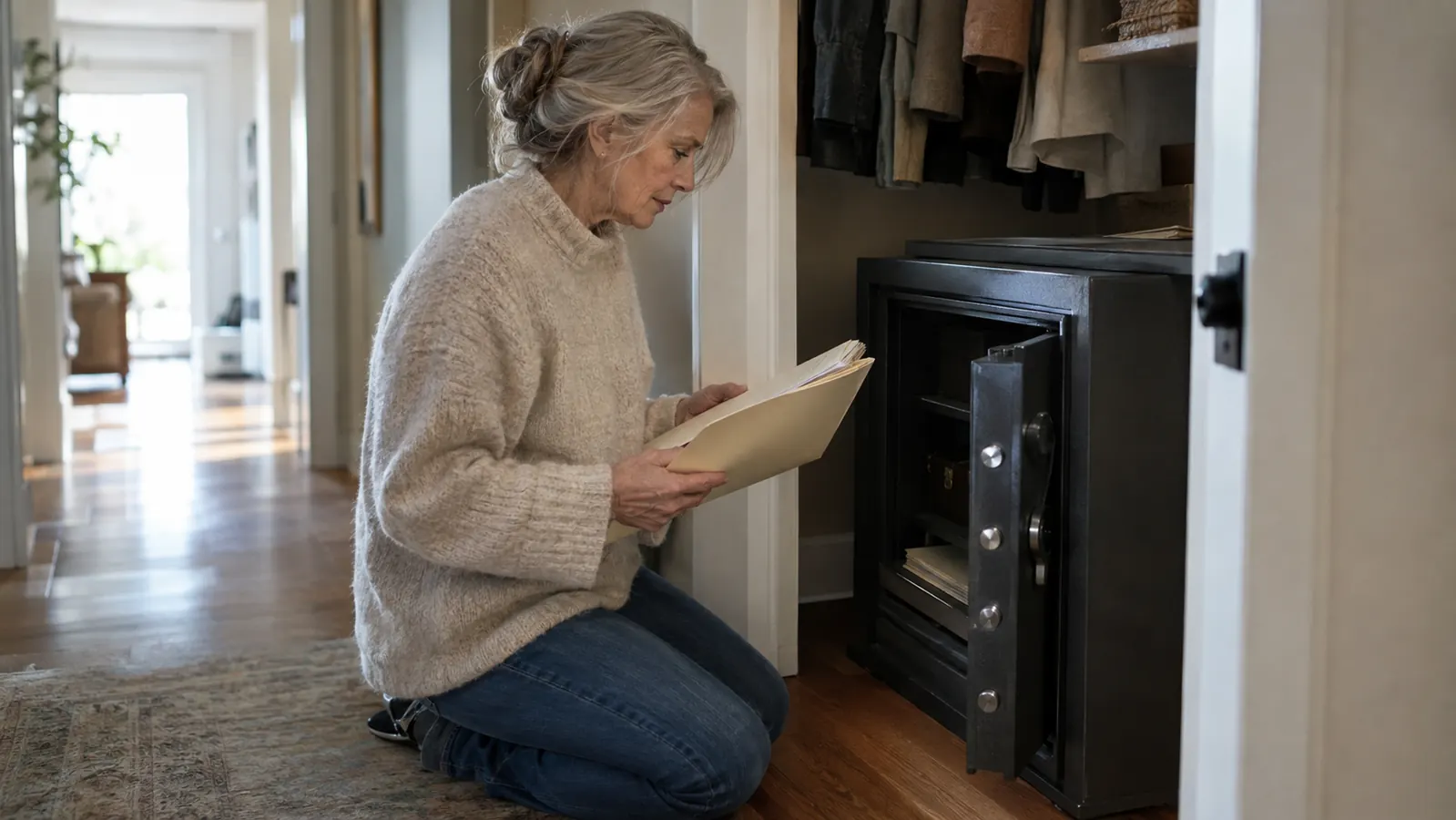
The question I heard most often in 25 years as a homeowners insurance claims adjuster was not about coverage. It was about paperwork. After a house fire, people would stand in the driveway in the middle of the night and ask me what they were supposed to do about the deed, the car titles, the passports, the policies that were still inside. I never had a comforting answer, because the papers were gone. The house could be rebuilt. The paperwork was a different problem entirely.
That is why I bought a SentrySafe 1-hour fireproof safe with a digital keypad about two years ago. It replaced the plain metal lockbox I had kept in the hall closet for years, the one that would have done nothing for my papers in a real fire. This article is the system I use now: five steps that start with the safe itself and end with the habits that keep it useful long after the purchase is forgotten.
The 1-Hour Safe That Holds What You Cannot Replace
The SentrySafe 1-hour fireproof safe is the one I bought to replace my old lockbox. It holds the deed, the car titles, the passports, the insurance policies, and my backup hard drive, and the digital keypad opens fast when I need it. If you are starting from scratch, this is where I would start.
Amazon Check Today's Price on Amazon →The five steps below are the ones I walk through with friends and family when they ask what to do first. None of them take a full afternoon, and none of them require a home improvement budget. The hard part is not the work. It is deciding to do it before you need it, on a Tuesday in March when nothing is on fire.
Step 1: Know What You Are Protecting Before You Buy Anything
Before you buy anything, sit down with a legal pad or a notes app and list every document that would be painful to replace. The short list for most households: the deed to the house, car titles, passports, birth certificates, marriage and divorce records, Social Security cards, insurance policies, tax returns for the last several years, wills and powers of attorney, and a list of bank and investment accounts. You will probably find that the list is shorter than you expected, which makes the rest of this easier.
Then add the things that have no replacement at all. For me that is my mother's jewelry and the backup hard drive with the family photos. For you it might be a child's artwork, a journal, or a folder of letters from someone you miss. The point of the inventory is not to be thorough for its own sake. It is to separate what you must keep from what you can replace, so the safe does not become a junk drawer that happens to be fireproof.
Keep a copy of the list where you can find it after a fire. I keep a printed version in a plastic sleeve inside the safe and a photo of the list on my phone. I also sent a copy to one of our children, who lives out of state, so there is a version of the list that a fire in Albuquerque cannot touch. If you have someone you trust who lives somewhere else, do the same.
Step 2: Match the Fire Rating to the Real Risk
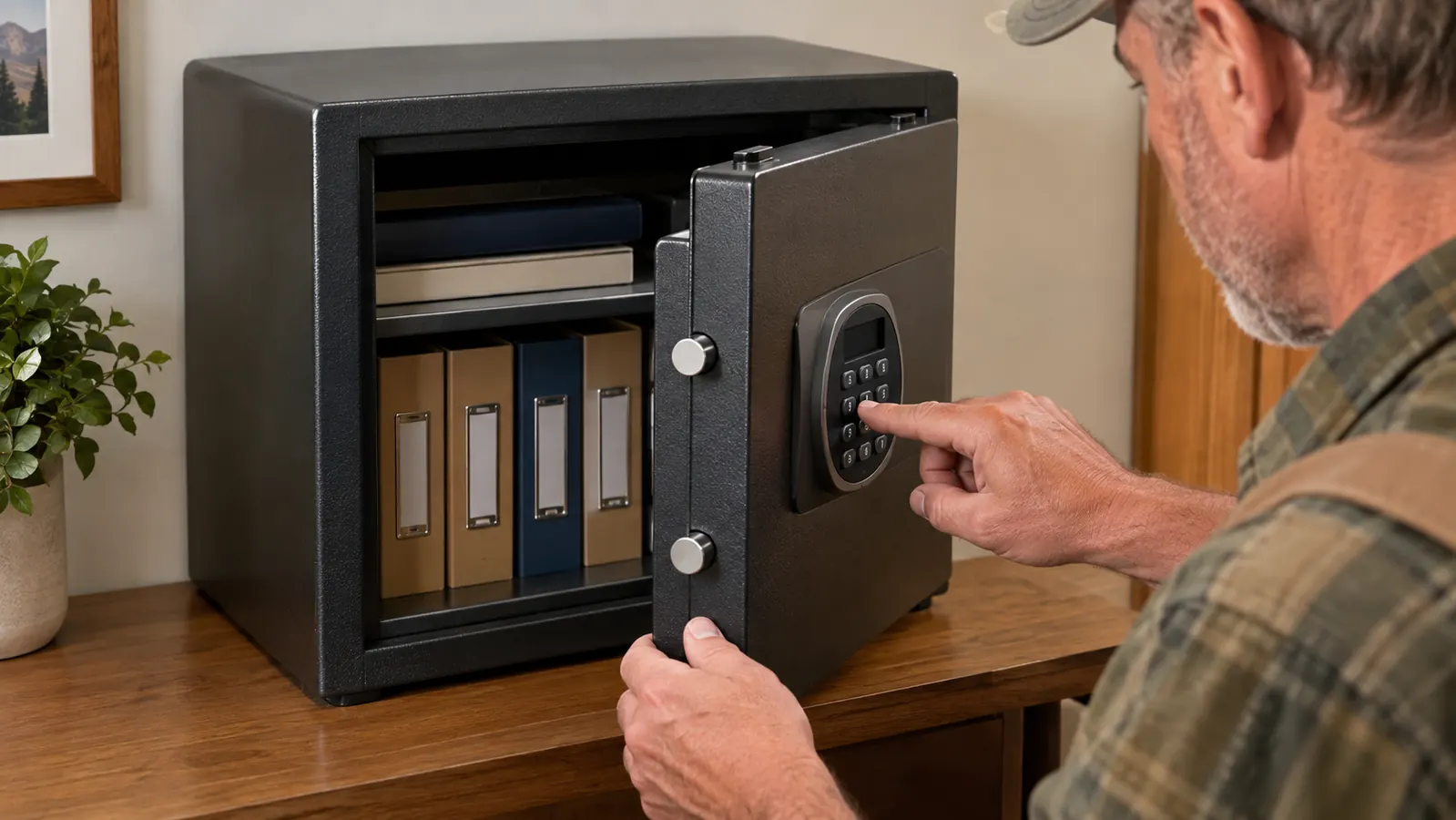
The rating on a fireproof safe tells you how long the inside stays cool enough for paper to survive. The SentrySafe I bought has a one-hour rating, which means the interior should stay below the temperature where paper begins to char for about an hour in a typical house fire. Most house fires burn hot and fast, and the fire department usually arrives well inside that window, so one hour is a reasonable target for a home. I would not buy a safe with less than a one-hour rating for papers I could not replace.
Two things I tell people about ratings. First, the rating assumes the safe is closed and sitting where a fire can reach it evenly, so placement matters, and I will get to that in Step 3. Second, a fireproof safe is not a burglar vault. It is built to protect against heat, not against someone with a pry bar and time. The SentrySafe delays and deters. That is what I promise it does, and nothing more. If you need real theft protection, that is a different product and a different conversation.
Size matters too. The 1.2 cubic foot size sounds small until you put a stack of letter-size folders in it. Mine holds the deed, the car titles, the passports, the insurance policies, a folder of tax returns, some emergency cash, and the backup drive, with room to spare. If your pile is bigger, buy bigger. If you are not sure, buy bigger anyway. A safe that is too small will end up with papers stacked on top of it, which is exactly where they should not be.
Step 3: Put the Safe in the Right Place and Bolt It Down
Where the safe lives matters almost as much as the rating. I keep mine bolted to the floor of the hall closet, which sounds like an odd choice until you think about where house fires start. Most start in the kitchen, the garage, or a bedroom, and they move up and outward. An interior closet on the ground floor is about as far from the usual starting points as you can get, and the floor gives the safe a solid base that stays cooler than the ceiling. Ray calls it the boring spot. I call it the spot with the best odds.
Bolting it down does two jobs. It keeps the safe from being carried off by someone who breaks in, and it keeps the safe from falling through a burned floor during a fire. The SentrySafe has holes in the bottom for bolting, and the installation took me about twenty minutes with a masonry bit and a handful of lag bolts. If you rent, ask your landlord first. If you cannot bolt it down, put the safe in the lowest, most interior spot you have and make it heavy enough that two people would struggle to move it.
One more placement note: do not put the safe in the garage. Garages are full of fuel sources, and a fire that starts in a car or a can of gasoline will hit the safe from every side at once. I have seen garage safes come through fires with their contents cooked. The hall closet is not glamorous, but it is an interior room on a concrete slab, and that is what you want. The safest place in your house is usually the least interesting one.
Step 4: Organize the Inside So You Can Close It and Walk Away
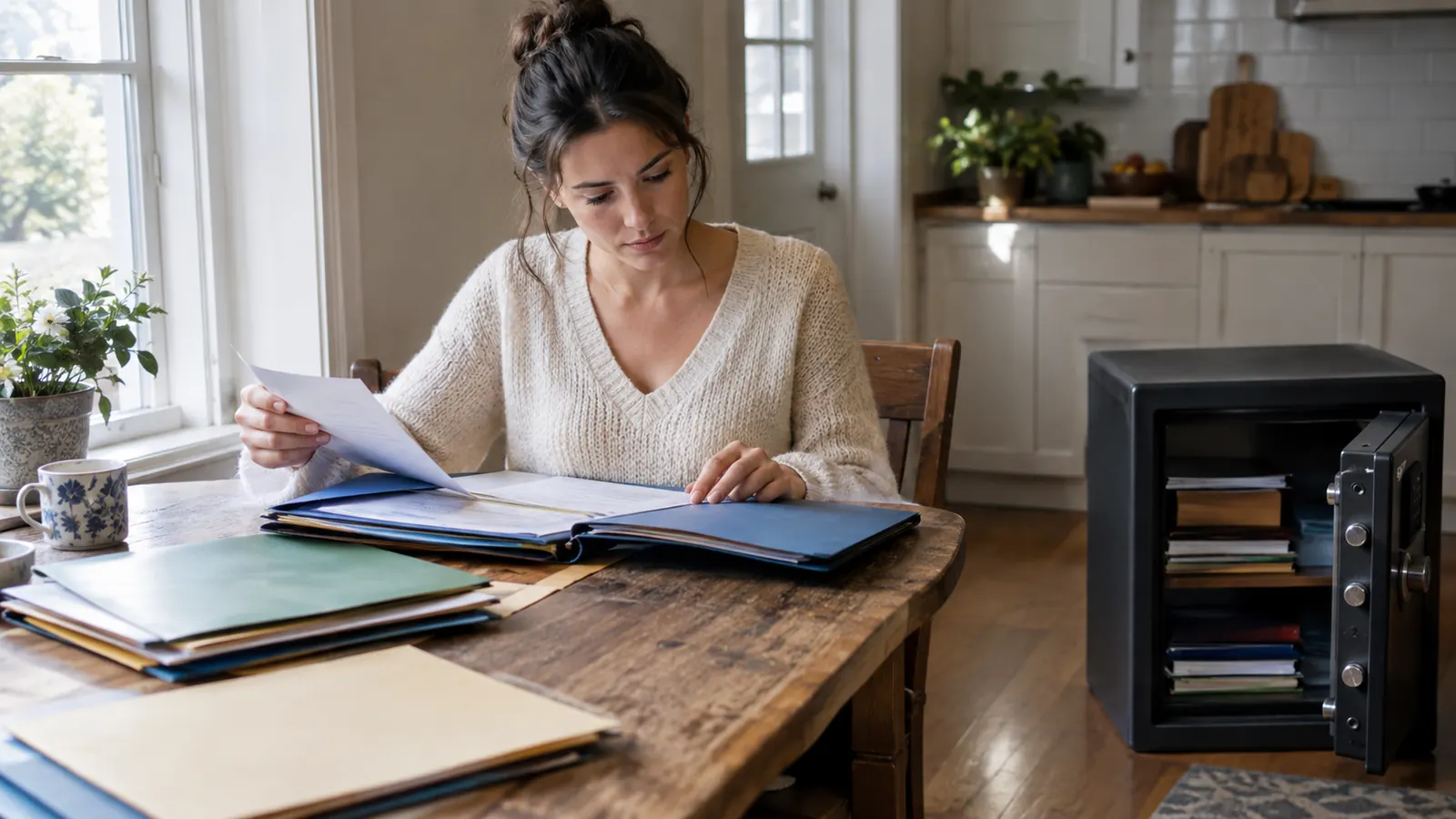
The inside of a fireproof safe does not need to be a filing cabinet. It needs enough order that you can see everything at a glance and grab the whole stack if you ever have to. I use a few fireproof document envelopes inside the safe, one for identity documents, one for property documents, one for financial documents, and one for the things that cannot be replaced. Each envelope is labeled on the outside with a marker. That is the whole system, and it has survived two annual reviews without changing.
Plastic sleeves matter more than people think. A fireproof safe protects against heat, but water is a separate problem. Firefighters put out fires with water, and a safe that sat in a hot fire can collect condensation as it cools. I keep every document in a plastic sleeve or a zippered bag inside its envelope, so even a damp interior does not ruin a paper I cannot replace. The sleeves are inexpensive, which makes them the cheapest insurance in this entire article.
Cash and small valuables sit loose in the bottom of mine, inside a zippered pouch so they do not slide under the envelopes. And here is the rule that keeps the safe useful: if a piece of paper goes in, a piece of paper comes out. Once a year I pull everything out, shred what is outdated, and put the stack back in the same order. The safe stays at about eighty percent full, which is the point where I can still close the door without wrestling it.
Step 5: Keep a Grab-and-Go Copy Kit Outside the Safe
The safe protects papers where it sits, but it cannot help you if the fire is between you and the closet. That is why I keep a fireproof document bag on the shelf beside the safe with the copies I would need in the first week after a fire: a copy of the insurance policy, a copy of the deed and the car titles, photocopies of passports and IDs, and a list of account numbers. The bag takes up almost no room, and it has been there so long that I forget it is part of the system until I need to think about it.
The bag is not a replacement for the safe. It is a redundancy. If I have thirty seconds, I grab the bag and the backup drive and I am out the door. If I have no time at all, the originals are still in the safe. Either way, I am not standing in the driveway with nothing but the clothes I am wearing. That was the scene I saw over and over as an adjuster, and it is the one I refuse to repeat in my own house.
Review the bag twice a year, at the same time you review the safe. Replace expired IDs, update the policy copies when you renew, and swap in the current tax return after April. The system only works if the copies are current, and a twice-a-year review takes about ten minutes. I do mine on the first weekend of June and the first weekend of December, because those dates are easy to remember.
What Else Helps
A safe is the backbone of the system, but a few cheap habits make it stronger. Scan your important documents and keep the scans on the backup drive inside the safe, with a second copy in the cloud or with a relative out of state. If the originals are damaged, the scans are enough to start the replacement process, and they are enough to prove to an insurer what you owned. I scanned our whole file box in one afternoon.
Take a video walkthrough of your house once a year. Open closets and drawers, narrate what you see, and store the video outside the house. After a fire, that video is the difference between a smooth claim and a fight over what was in the living room. It took me forty minutes to film our house, and it is the single most useful thing most people never do. Ray thinks I am being dramatic until I remind him what I used to see at work.
Two small maintenance habits keep the whole system working. The digital keypad on the safe runs on a battery, so I replace mine once a year on the same weekend I review the safe, which means I am never standing in front of a locked safe with a dead keypad. And tell one person you trust where the safe is and how to open it. If you are hurt or away from home, that person may be the one who needs to get the documents for you.
Finally, do not aim for perfection. A safe that holds the most important things and a bag that holds the copies is already ahead of most households. I spent years as the person telling families what they had lost. Now I spend a few minutes a year making sure my own list is current, and that small habit is the whole difference between dreading the worst case and being ready for it.
In 25 years of claims work, I never saw a fire give anyone time to sort through a drawer. The papers survive only if they are already in the safe.
The Safe That Makes the First Step Easy
The SentrySafe 1-hour fireproof safe is the same model I bought to replace my old lockbox. The five steps above work with any safe that has a one-hour rating, and this one is the model I tell people to start with.
Amazon Check Today's Price on Amazon →