
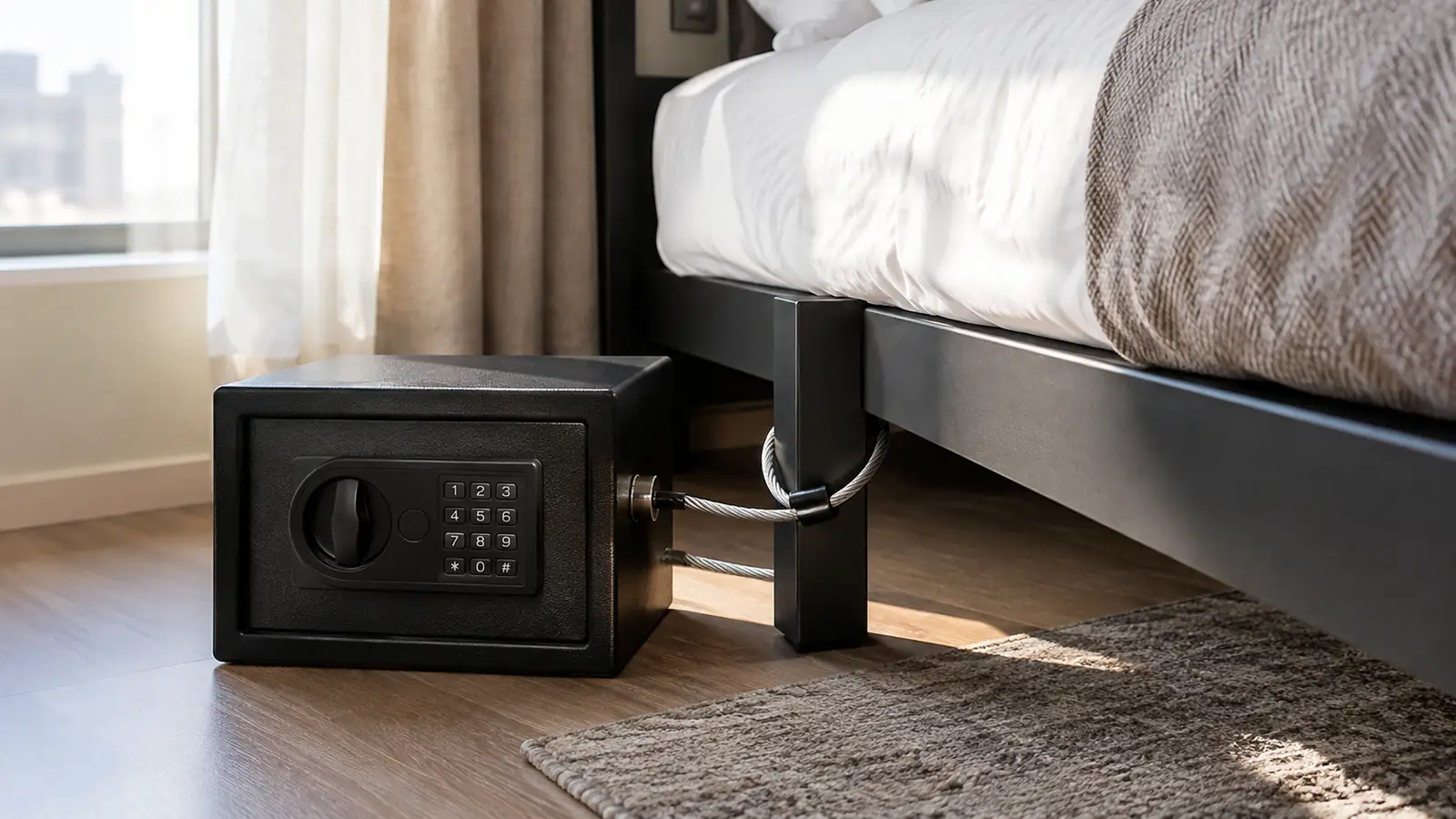
I spent twenty-five years as a homeowners-insurance claims adjuster, which means I walked through a lot of houses after the police left. I saw what burglars took, what they missed, and where people hid things that every burglar checked first. So when I started traveling again after I retired, I had a short list of what I wanted in a travel safe, and the Master Lock travel safe with cable checked most of the boxes. This is the honest version of that review, the one that tells you what the listing photos do not.
The short version: it is a small combination safe with a steel cable, and you wrap the cable around something solid, like a bed frame or a seat frame in the car. It does not make your things unstealable. Nothing portable does. What it does is make stealing them noisy, slow, and obvious, which is usually enough to send a thief to an easier room. That distinction matters, and most reviews skip it.
The Quick Verdict
A capable, honest deterrent for hotel rooms and road trips. Not a fire safe, not a vault, and not meant to be one. If you treat it as what it is, a way to stop grab-and-go theft, it earns its place in your bag.
Amazon Check Today's Price →The travel safe I now pack for every overnight trip
It won't stop someone with bolt cutters, but it stops the theft that actually happens in hotels: the open door, the quick grab, the room that looks untouched. Check today's price on Amazon and decide if that peace of mind is worth it.
Amazon Check Today's Price on Amazon →How I've Used It
I bought the Master Lock travel safe about four months ago, right before a stretch of road trips to visit our two kids out of state. We stayed in a mix of hotels, a cabin, and one very nice Airbnb, and in every room the safe came out of the suitcase and got cabled to something solid. In hotels I used the bed frame. In the cabin I used a pipe in the bathroom. In the car, when we stopped for lunch or a hike, I looped the cable around the seat frame and tucked the safe under the seat.
What went inside changed by the day. Passports and IDs on the days we flew. Spare cash. My mother's jewelry, which I do not like leaving in a hotel room even when the room has its own safe. The backup drive with family photos, on the days we were gone for hours. It is not a big safe. It holds the things you would grab in a fire, not the things you would need for a month.
The habit took about one trip to form. The first real test came in early July, on a four-day drive to see our son in Phoenix. We stopped for the night at a motel off the interstate, the kind with exterior doors that open onto the parking lot. I ran the cable around the leg of the metal bed frame, the kind welded to the headboard rather than the sort on casters, and tucked the safe underneath. In the morning it was exactly where I left it, and the room looked untouched. That is the outcome you want: nothing happens, because nothing looked easy. Now the safe goes in the suitcase the same way my toothbrush does. I do not think about it anymore. I just pack it, and when we get to a room, the first thing I do is find the anchor point and run the cable around it.
What the Cable Actually Does, and What It Doesn't
Here is what nobody tells you about cable safes, from someone who has read a lot of theft reports. The cable is not a lock. It is a delay. It is made of steel, it is hard to cut quietly, and it takes time and a tool to defeat. A thief who is walking a hallway looking for an open door is not carrying bolt cutters. A thief who is in your room for ninety seconds is there to grab and go. The cable turns a two-second grab into a two-minute project, and that is the whole point.
On the other side of the ledger, I have seen what happens when someone really wants what is in a safe. Bolt cutters defeat most cables. A determined person can cut the cable, or cut the bed frame, or just take the whole thing and worry about it later. If you are protecting against a professional, this safe is not the answer, and no travel safe is. If you are protecting against the opportunistic theft that actually happens in hotels, the cable is exactly the right tool. I remember one claim from maybe six years back, a family on vacation who left their passports and a camera bag on the dresser while they went down for breakfast. The room was hit in the eleven minutes they were gone. The thief took the camera bag and left the passports, which tells you everything about the mindset. They wanted the easy grab. A cabled safe on the floor would have changed the math on that room.
The other thing the adjuster in me notices: the safe is visible. That is a feature. A thief who sees a cabled safe knows there is something worth protecting, but also knows it will take work to get to it. In the reports I read, the rooms that got hit were the rooms that looked easy. A visible safe with a cable makes your room look harder than the next one.
The Combination Dial: Practice Before You Need It
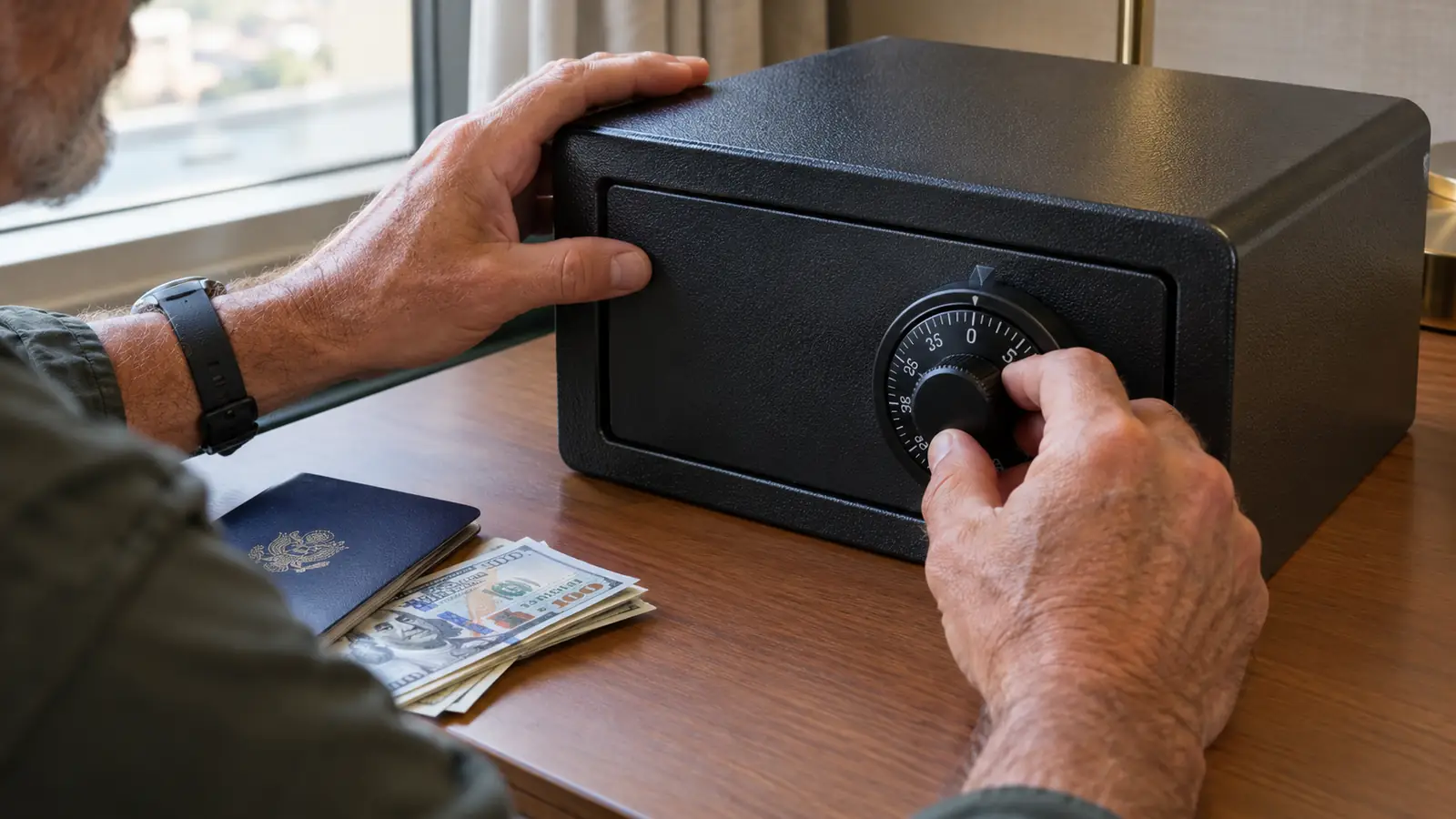
The Master Lock travel safe uses a combination dial, not a key and not a battery-powered keypad. That is a tradeoff, and it cuts both ways. No batteries means nothing to die at the worst moment, and no key means nothing to lose in a parking lot. But a combination dial has its own failure mode: it requires practice, and the first time you use it in a dark hotel room at midnight is not the time to learn.
My advice is to set the code at home, then open and close it ten times before it goes in the bag. Do it with the lights on, then with the lights off. The dial has a feel to it, and that feel does not transfer from reading the instructions. The first time I set the code, I did it wrong. I followed the instructions, closed the door, and the dial spun freely, which is the safe telling you the code did not take. Ray watched me do it twice more before I got the sequence right. That is exactly the kind of mistake you want to make in the kitchen at noon, not in a parking garage at eleven at night. I also wrote the code down and kept it in my wallet, not taped to the safe. Taping the code to the safe is the equivalent of leaving the key under the mat, and I have seen that exact mistake in real homes.
The reset process is straightforward when the safe is open, which is the only time you should be doing it. If you forget the code while the safe is locked, you are stuck until you remember it, so the ten minutes of practice at home is genuinely worth it. This is the kind of detail that reviews skip because it is not dramatic. It is the detail that determines whether you actually use the thing.
What the Claims Files Taught Me About Hotel Theft
Over the years I handled more than a few claims that started with a hotel room door left ajar or a rental car window smashed. The pattern was always the same. The thief did not come prepared for a safe. They came prepared for an easy grab. They opened drawers, checked the closet shelf, looked under the mattress, and left in under two minutes. The people who lost the most were the ones who made it easy.
That is why I keep the Master Lock travel safe visible and cabled, rather than hidden in a drawer. A drawer is the first place a thief looks. A cabled safe on the floor is a problem they did not plan for. It does not make you a target. The things you carry make you a target. The safe just makes the grab harder, and harder is usually enough.
People ask me where to put a safe in a hotel room, and the answer is simple: anywhere the cable can wrap around something that is not going to move. Bed frames are the obvious choice, and most of them work well. I have also used the frame of a heavy desk, the pipe behind a toilet, and the leg of a solid dresser. The goal is an anchor that would take tools to remove, not something a person can lift and walk away with. I would not trust a closet rod, a towel bar, or a curtain rod; those look solid and are not.
The other rule I use comes from twenty-five years of reading burglary reports: do not hide the safe. Put it somewhere visible but awkward, like on the floor beside the bed or in the open closet. A thief who has to kneel down and work at a cable on the floor is a thief who is spending too much time in your room. The rooms that get hit are the ones that look like a quick in-and-out.
The Honest Tradeoffs
This is the part of the review where I tell you what the Master Lock travel safe is not, because the marketing will not. It does not claim a fire rating, and it does not claim a water rating. If the hotel burns down or the car ends up in a flood, the safe will not save what is inside. That is why I keep the irreplaceable things, the deed, the titles, the policies, in the bolted safe at home, and I use the travel safe for the things I need on the trip. Before I bought it, I tried the hotel room safe, and I tried hiding things in the room. The hotel safe worked when it worked, but the batteries died once, and the front desk had an override code, which means the staff can open it and so can anyone who talks them out of it. Hiding things under the mattress or in a suitcase is exactly what every thief expects. The travel safe replaced both habits.
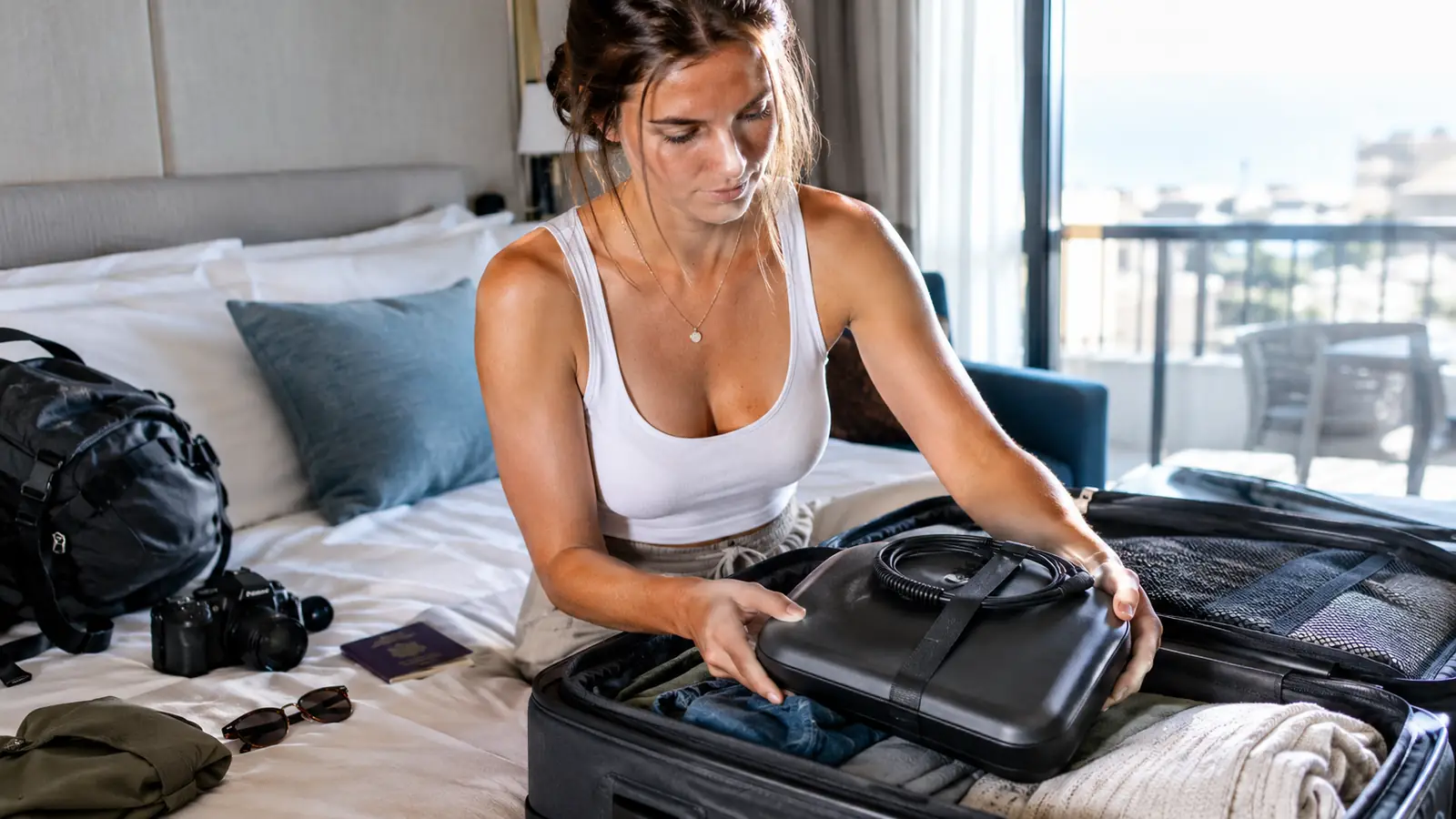
It is also small. The listing calls it small, and it means it. It is about the size of a hardcover book, which is why it slides into a carry-on without a second thought. Passports, cash, jewelry, a phone, a small camera, that is the honest capacity. If you travel with a laptop, a tablet, or a camera with a long lens, this is not the safe for that job. You would need a larger portable safe, and you would pay for it in weight and bulk. I would rather carry the small one and leave the laptop in the room safe or the car.
And the cable, while useful, is not infinite. You cannot cable the safe to a luggage rack and also to the bed frame and also to the car seat at the same time. You pick one anchor per location, and you re-cable when you move. That sounds obvious, but I have watched people skip it because they were tired after a long drive. The safe only works when it is actually cabled to something. Sitting loose in a suitcase, it is just a box.
What I Liked
- Small and light enough to pack in a carry-on without thinking about it
- Steel cable anchors to bed frames, seat frames, and other solid points
- No batteries and no key, so nothing to lose or run flat
- Resettable combination means you are not stuck with a factory code
- Honest deterrent that makes your room look harder than the next one
Where It Falls Short
- No fire or water rating claimed; keep irreplaceable documents out of it
- A determined thief with bolt cutters can defeat the cable
- Combination dial needs practice, especially in the dark
- Interior is small; no laptop, tablet, or long-lens camera
- If you forget the code while it is locked, you are stuck until you remember it
A cable safe does not make your things unstealable. It makes them the hardest thing in the room to grab, and that is usually enough.
Who This Is For
The Master Lock travel safe is for people who spend nights away from home and carry things that would ruin a trip if they disappeared. Passports, spare cash, jewelry, medication, a backup drive. It is for the road-tripper who stops for lunch and does not want to leave everything loose in the car. It is for the parent traveling with two kids and a rental car full of luggage. It is for the person who has seen the inside of a hotel room after a theft, or who has read enough reports to know what it looks like.
It is also for people who understand what a deterrent is. If you are looking for a device that makes theft impossible, keep looking, because it does not exist. If you are looking for a way to make your things the hardest thing to grab in the room, this safe does that job well. That is the honest measure, and by that measure it earns its place in the bag.
It is also for the person who travels with medication that cannot be left behind, or the one who carries a backup drive with years of family photos. Those things are not worth much to a thief, but they are worth everything to you, and losing them ruins a trip in a way a stolen credit card does not.
Who Should Skip It
Skip the Master Lock travel safe if you need fire or water protection. It does not claim either, and I would not want anyone to buy it thinking it does. If the documents you carry are irreplaceable, the kind you could not reconstruct with a phone call, they belong in a fire-rated safe at home, not in a travel safe in a hotel room. That is the adjuster in me talking, and it is the advice I would give my own kids.
Skip it if you need to secure a laptop or tablet on a regular basis, because the interior is too small. Skip it if you know you will not practice the combination, because a combination you cannot open in the dark is a combination that will fail you at the worst moment. And skip it if you want a keyed lock or a digital keypad; this is a mechanical dial, on purpose, and if that is not your preference, there are other options that fit your style better.
And if you are the kind of traveler who will not take the ten minutes to set the code and practice it, this safe will frustrate you. Buy it, use it, or leave it at home. A safe you cannot open is worse than no safe at all, because it gives you a false sense of security.
If you travel with passports, cash, or jewelry, this is the cheapest peace of mind I know
It is not a vault, and I would never tell you it is. It is a solid, honest deterrent that takes the grab-and-go out of hotel theft. Check today's price on Amazon and see if it fits your bag.
Amazon Check Today's Price on Amazon →