
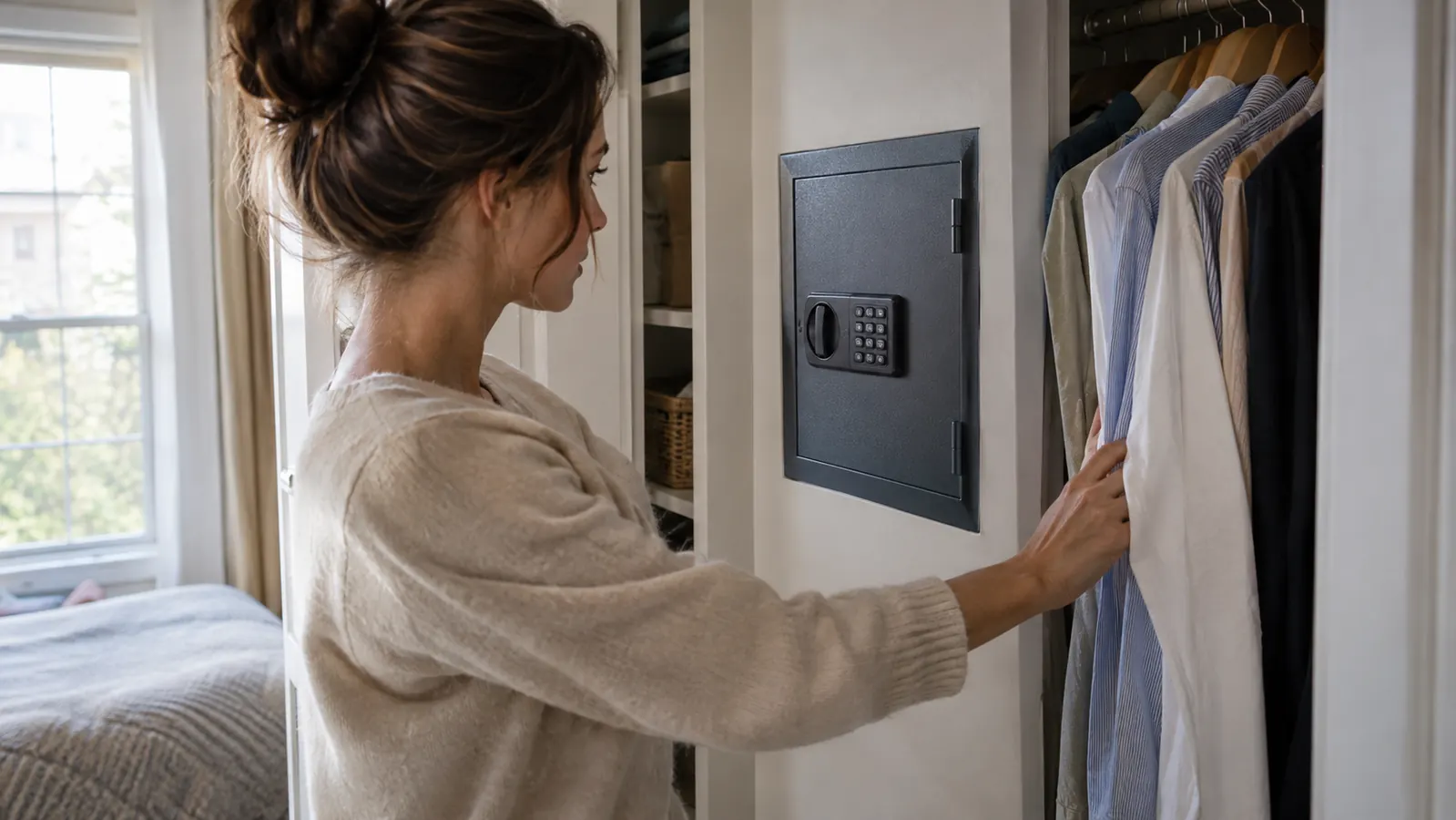
After 25 years as a homeowners-insurance claims adjuster, I can tell you exactly where people hide things: the sock drawer, the freezer, the shoebox on the closet shelf. I can also tell you where burglars look first: the sock drawer, the freezer, the shoebox on the closet shelf. The hiding spots most people trust are the ones thieves check first, because everyone uses them.
That is why, when my husband Ray and I installed a Paragon Lock & Safe in-wall safe between the studs of our bedroom closet wall about six months ago, we did not put it where a hand naturally reaches. We put it where a thief would not think to look: behind the hanging clothes, flush with the drywall. Here are the ten practical reasons an in-wall safe keeps valuables out of sight, in the order I would explain them to a friend.
The safe that disappears into your closet wall
The Paragon Lock & Safe in-wall safe mounts flush between the studs, so it reads as wall, not safe. Keypad entry, two manual override keys, and it cannot be carried out of the house. Check today's price on Amazon and see if it fits your closet.
Amazon Check Today's Price on Amazon →It hides where burglars rush past
The master bedroom closet is the first place a burglar checks, but only at eye level and below. In the claims I worked, they pulled open drawers, swept the shelf, and dumped the shoeboxes onto the floor. They did not push hanging clothes aside to study the wall behind them. Our Paragon Lock & Safe sits flush between two studs behind Ray's shirts, and in six months of daily use, not one visitor has noticed it. That is the difference between a hiding spot and a place a thief never thinks to look.
Flush mounting makes it read as wall
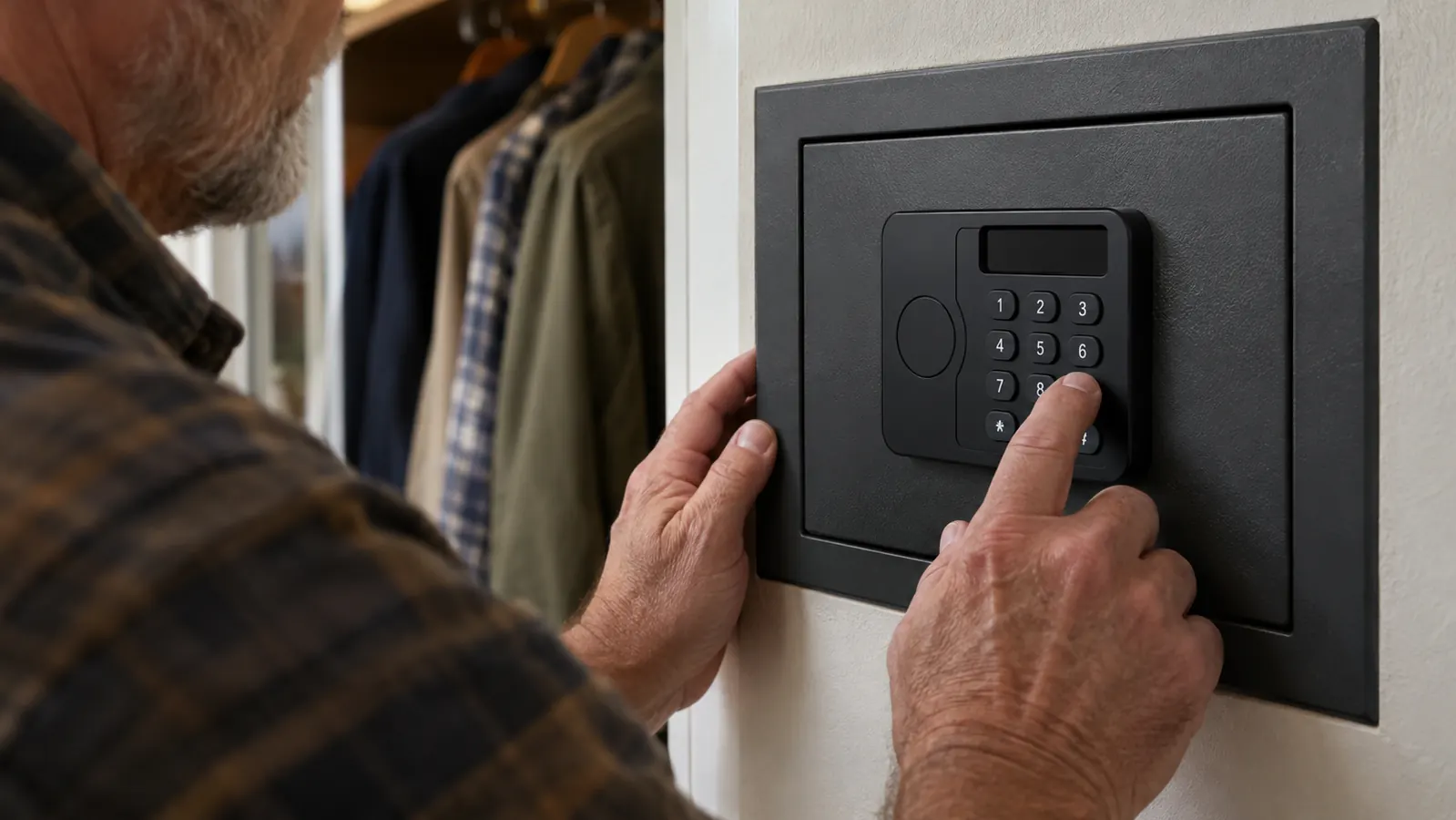
Once the trim is on and the front sits level with the drywall, the safe reads as part of the wall, not as a safe. From three feet away, it is just a flat rectangle behind the clothes. That is the entire point of an in-wall safe: it does not announce itself the way a freestanding steel box does. A freestanding safe says 'valuables here' to anyone who walks into the room. The Paragon Lock & Safe says nothing at all. I have watched guests scan a room and register every surface. They do not register a wall.
It cannot be picked up and carried out
The plain metal lockbox I used for years could be lifted by one person and opened at leisure in a garage. An in-wall safe is anchored between the studs, so it cannot be carried out of the house. A thief would need a pry bar, time, and a willingness to make noise. Most burglars want to be gone in under ten minutes, and that math is on your side. In the claims I saw, the safes that got carried off were the ones that could be carried off.
It uses dead wall space, not floor space
Our hall closet already holds the fire-rated SentrySafe bolted to the floor, and the bedroom closet is narrow. An in-wall safe uses the empty space between studs, so it adds security without stealing a single square foot of floor. In a ranch house where every closet is already full, that is a real advantage. You are not choosing between a safe and storage. You are putting the safe inside the wall and keeping the storage. The wall was going to be there either way. Now it earns its keep.
The keypad opens fast, with no key to fumble
A digital keypad means I can reach the spare cash and small items in a few seconds, even in the dark. The Paragon Lock & Safe also includes two manual override keys, which I keep in a separate spot as a backup. You never have to remember where you put the key, because the keypad is the key. For someone my age, that matters more than it used to. I do not want to be standing in a dark closet at 2 a.m. trying to remember which drawer holds the safe key.
It stays hidden even when the closet door is open
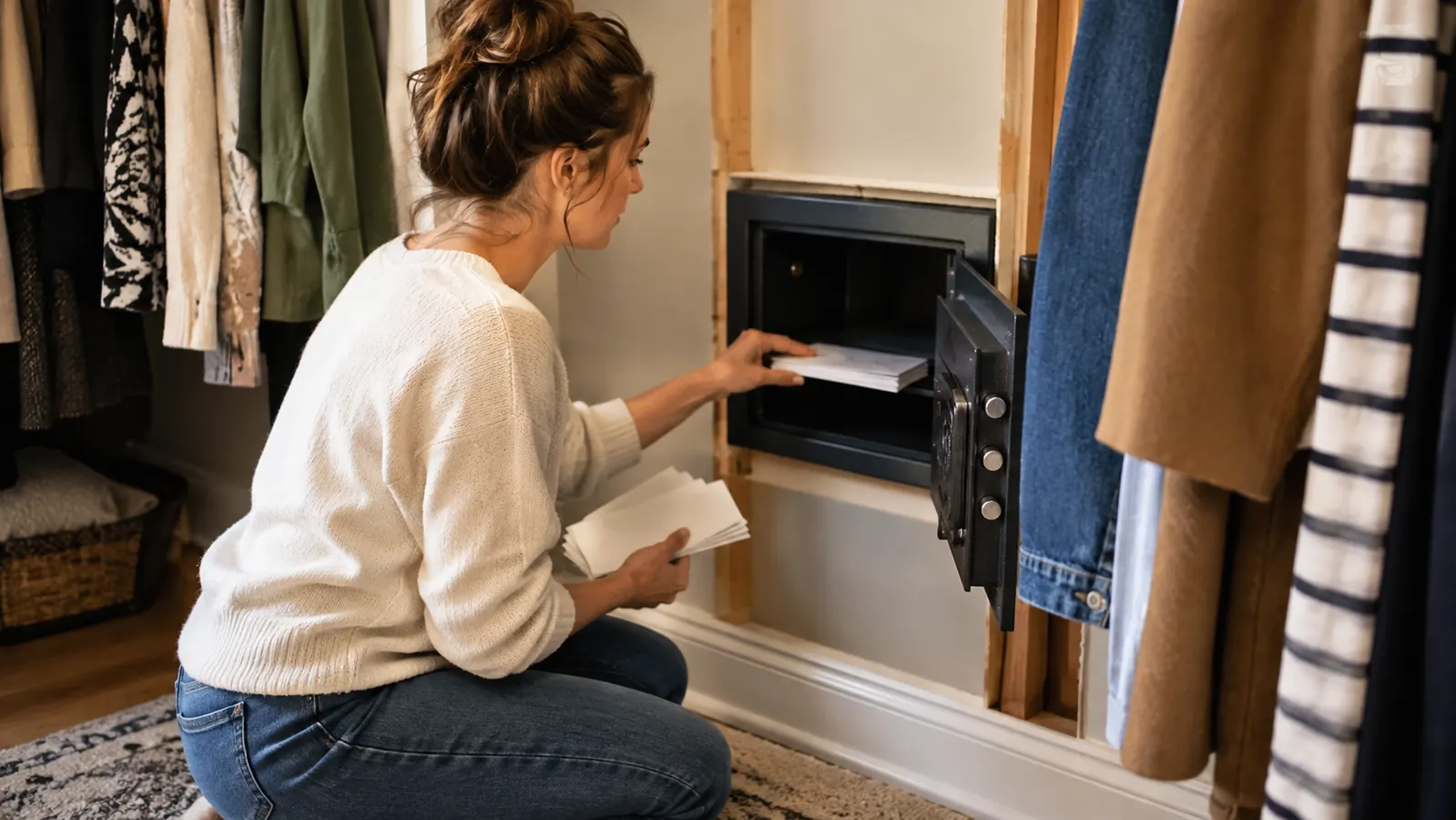
A safe on the closet floor is visible the moment the door swings open. An in-wall safe behind hanging clothes stays covered whether the door is open or shut. Guests walking past the bedroom never see it, and neither does the person who comes in to grab a coat. The clothes do the hiding for you, and they were going to hang there anyway. That is the elegance of the design: you are not adding anything visible to the room. It is the closest thing to a hiding place that still feels like a normal room.
It survives the ten-minute ransack
In my adjusting years, the typical burglary was fast and messy: mattress flipped, dresser drawers dumped on the bed, jewelry box emptied on the floor. Nobody pulled every shirt off the rod and inspected the drywall. The safes that survived were the ones that were not visible in the first pass. An in-wall safe behind clothes is not part of that first pass. It takes a different kind of search to find it, and most burglars do not have the time for a different kind of search.
It is invisible to service people and guests
The electrician, the housecleaner, the holiday guest: none of them need to know where you keep cash and small valuables. A freestanding safe is an advertisement for itself. An in-wall safe behind clothes is not. I settled more than one claim where a safe was found because it was visible to someone who had been in the house. I am not saying the visitor was the burglar. I am saying that out of sight removes the question entirely, and that is a quieter way to live.
It delays a thief, and delay deters
No safe is burglar-proof, and I would not insult you by claiming one is. The job of an in-wall safe is to delay and deter. A thief who has to find a pry point, work a tool between the studs, and make noise is a thief who moves on to an easier house. That is the honest standard I use after a career of seeing what actually happens. A safe does not have to be impenetrable. It has to be more trouble than the next target.
It clears the nightstand and the dresser
Spare cash, a spare key, a watch, the small things that usually live in the top drawer: they have a place now that is out of sight and out of the way. The nightstand holds a lamp and a book again. The dresser drawer holds socks, not the things a burglar would want. It took one afternoon for Ray to install the safe between the studs, and it has changed how the whole room feels. The valuables are still close, but they are no longer the first thing anyone sees.
What I'd Skip
An in-wall safe is not a fire safe, and I would not pretend otherwise. It will not protect paper from a house fire the way a fire-rated document safe will. Our deed, the car titles, and the passports stay in the fire-rated SentrySafe in the hall closet for that reason. The Paragon Lock & Safe holds spare cash and small items that need to be out of sight, not documents that need to survive a fire. If fire protection is your priority, buy a fire-rated safe first and add an in-wall safe later. And if you rent, check with your landlord before cutting into a wall, because this is a permanent installation.
In six months of daily use, with the closet door open half the day, not one person has noticed the safe behind the clothes. That is the whole point.
Put your valuables where nobody looks
The Paragon Lock & Safe in-wall safe mounts between the studs, opens with a keypad, and keeps spare cash and small items out of sight. Check today's price on Amazon and see if it fits your closet.
Amazon Check Today's Price on Amazon →