
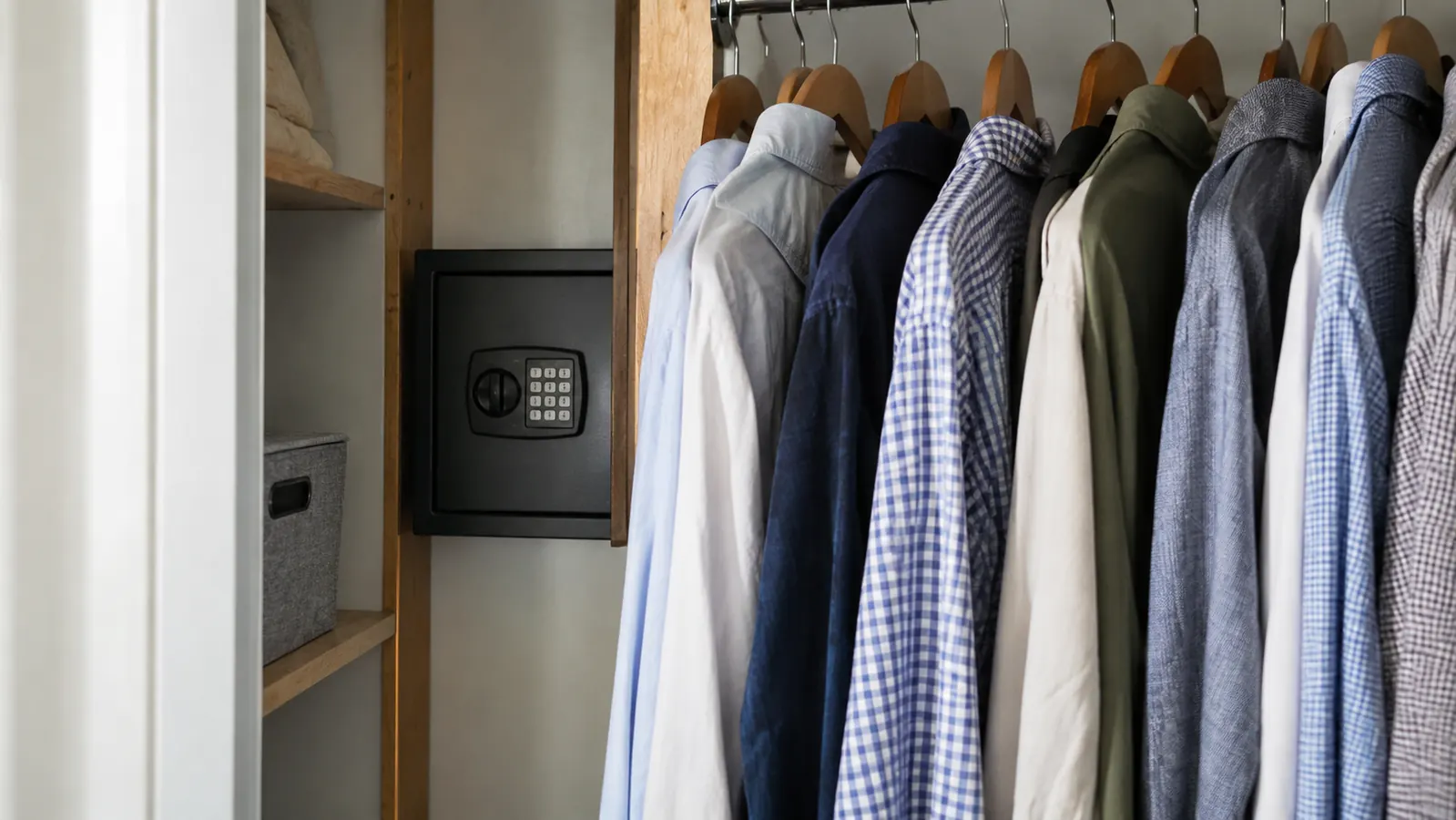
In twenty-five years as a homeowners-insurance claims adjuster, I walked through a lot of houses after the police had come and gone. The first question I always asked was the same: what did they take? The second question mattered more: where were you keeping it? The answer, more often than not, was the master bedroom. The top dresser drawer. The nightstand. The shoebox on the closet shelf. Burglars are not clever about this. They are thorough about the places that work, and they check them in the same order every time.
That is the real difference between a safe that hides and a safe that sits in plain sight. Six months ago my husband Ray and I mounted a Paragon Lock & Safe in-wall keypad safe between the studs of our bedroom closet, behind the hanging clothes. I still keep our old freestanding safe, a SentrySafe with a digital keypad, bolted to the floor of the hall closet. I use both every week. But I use them for different reasons, and if you are trying to decide between an in-wall safe and a freestanding one, the question that matters is not which one is harder to break into. It is which one a burglar will find in the first place.
Where Burglars Actually Look
After a break-in, the homeowner would walk me through the house and I would see the same pattern. The living room got tossed quickly, cushions off the couch, drawers dumped. The kitchen got a fast pass through, mostly for pills and cash. Then the burglar went to the bedrooms. The master bedroom closet was checked first. The floor, the top shelf, the pockets of hanging coats. Under the bed. Inside the mattress cover. The bathroom cabinet. The freezer. I have seen valuables recovered from every one of those places, and I have seen them stolen from every one of those places too. The point is that burglars work from a checklist, and the checklist is short.
A freestanding safe changes the checklist. The moment a burglar sees a safe, they know two things: there is something worth protecting, and they have limited time to get it. Most residential burglaries are over in well under ten minutes. A visible safe becomes a project. They will try the handle, rock it, maybe put a pry bar to the door. If it is bolted down, they usually give up on moving it and go back to the checklist. An in-wall safe behind hanging clothes rarely makes it onto the checklist at all, because the checklist does not include cutting drywall or moving every shirt in the closet. I remember one claim from a Tuesday morning in March. The homeowners had been gone for the weekend, and the burglar came in through the back slider. He took the wife's jewelry from the master bath, the husband's watch from the nightstand, and a tablet from the living room. He never opened the master closet, because the door was closed and the room looked untouched. That is how fast the checklist works.
| Paragon In-Wall Safe | Freestanding Safe (like my SentrySafe) | |
|---|---|---|
| Where burglars look | Hidden behind hanging clothes in a bedroom closet; most burglars will not find it | Sits in plain sight; a visible safe advertises that valuables exist |
| If it gets found | A crowbar can pry it from the studs, but only if a burglar discovers it behind the clothes | Bolted to the floor and heavy enough that carrying it off is impractical, though a pry bar can still attack the door |
| Fire protection | The listing does not claim a fire rating; paper inside is only as safe as the wall around it | My SentrySafe carries a one-hour fire rating, which is why the deed and titles live in it |
| Capacity | Limited by the space between studs; fine for cash, jewelry, and small papers | Available in sizes from a small box to a full cabinet; holds file boxes and larger valuables |
| Floor space | Zero footprint; it disappears into the wall | Takes up closet or office floor space |
| Best for | Small valuables you want out of sight | Documents, larger items, and fire protection |
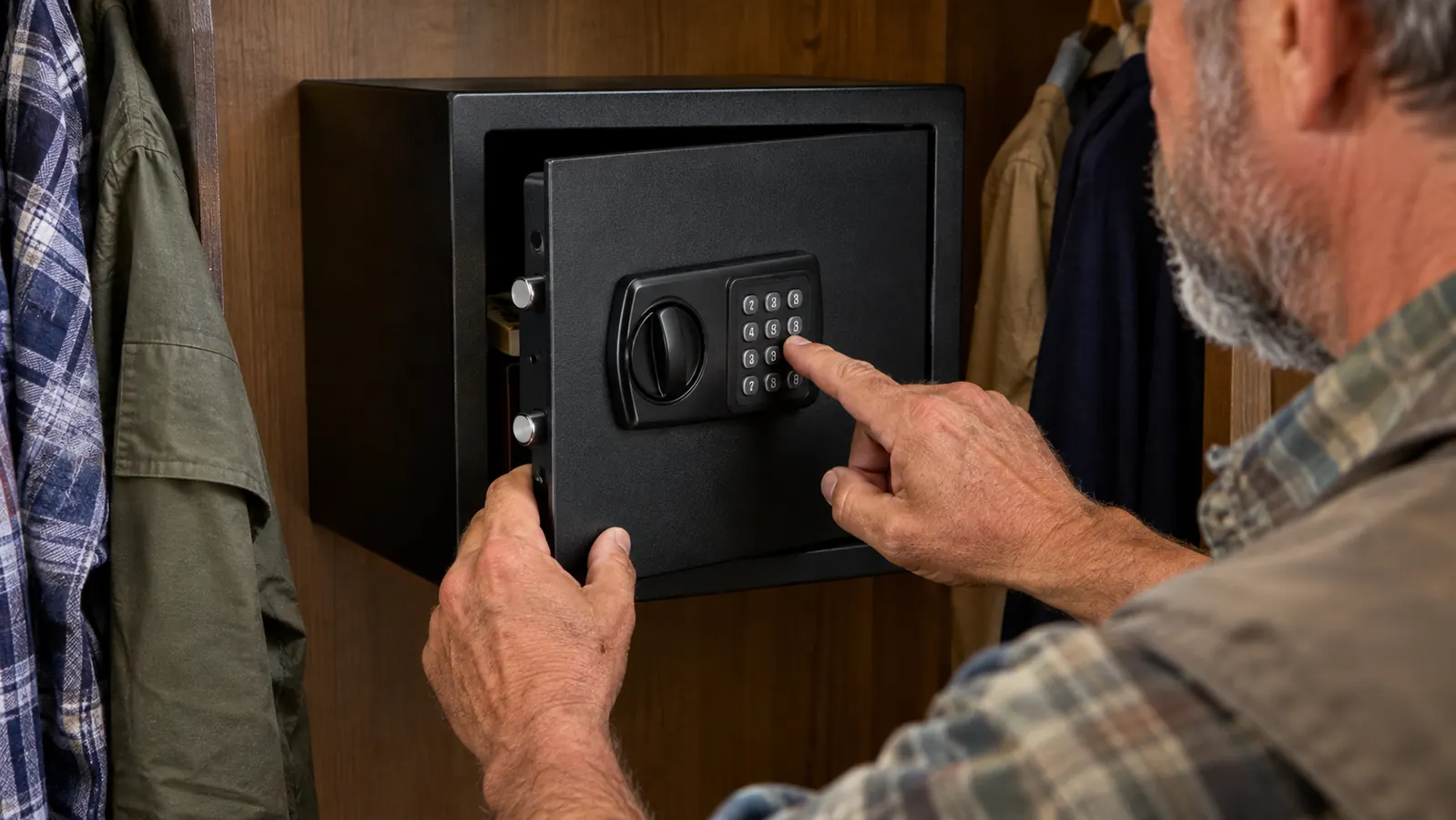
Where Paragon Lock & Safe Wins
The Paragon Lock & Safe wins the category that matters most to me, which is that a burglar is unlikely to find it. In six months, I have not once thought about whether the safe in the bedroom closet is visible from the doorway. It is not. Ray mounted it between two studs, and the door sits almost flush with the drywall. When the shirts are hanging, you cannot see it unless you push the clothes aside. That is the entire point of an in-wall safe. It does not try to be stronger than a burglar. It tries to be absent. In my experience as an adjuster, absence works. I have written claims where the only thing stolen from a closet was the jewelry box on the shelf, while a locked box in the same closet was never touched.
The second win is floor space. Our hall closet already holds the SentrySafe, the document bag, and a shelf of odds and ends. The bedroom closet had an empty wall between the studs and nothing else. The Paragon Lock & Safe cost us no floor space at all, which matters in a single-story ranch house where every closet does double duty. The third win is quieter, but real: an in-wall safe keeps small valuables out of the hands of guests and contractors. A repairman working in the bedroom is not going to find cash or jewelry that is hidden behind a row of shirts. That is not paranoia. It is just how I think after twenty-five years of reading police reports.
Where a Freestanding Safe Wins
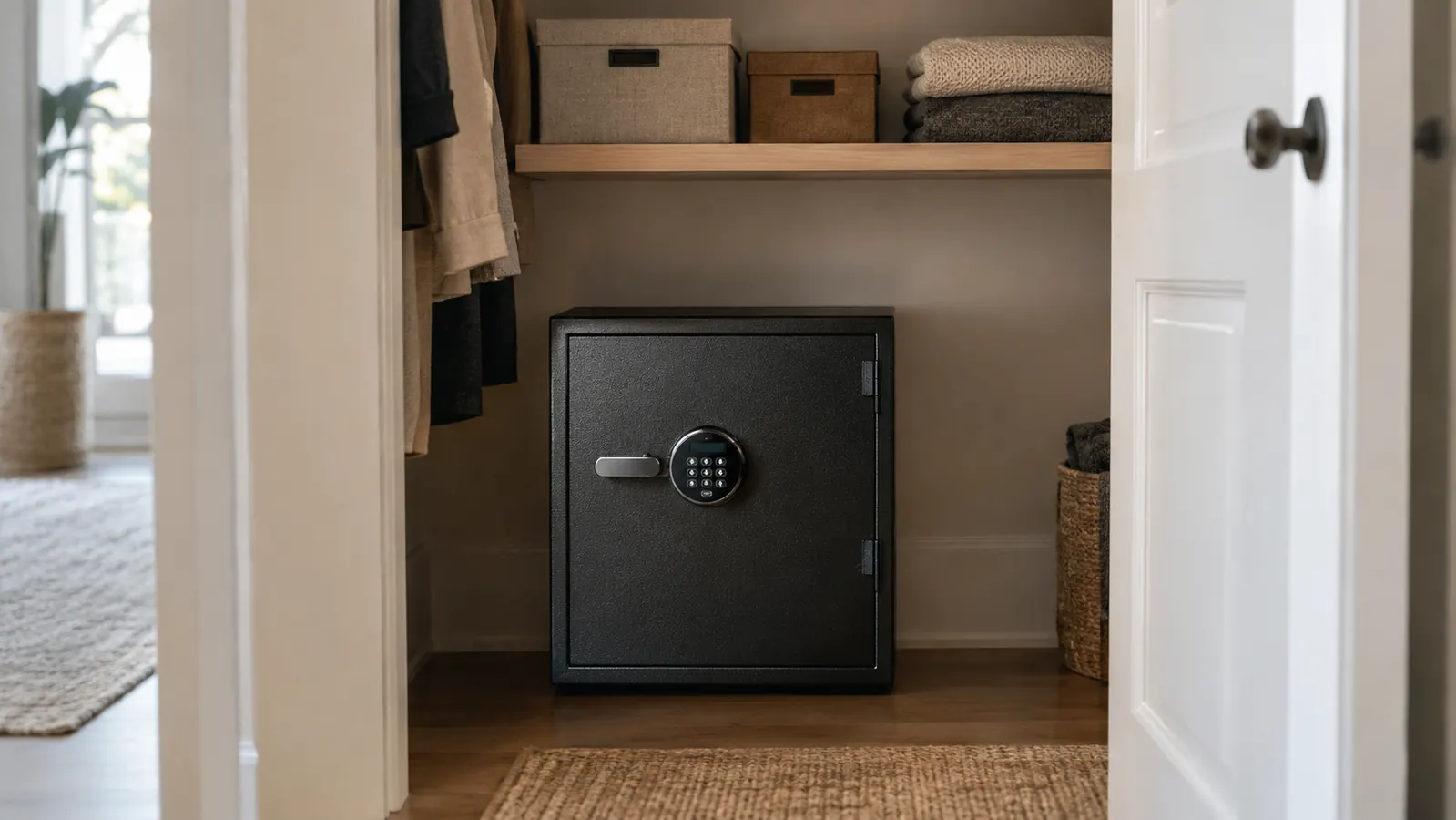
I would be lying if I said the freestanding safe was not the better choice for some things, and I have kept mine for a reason. Fire protection is the big one. The SentrySafe in the hall closet has a one-hour fire rating, and the Paragon Lock & Safe listing does not claim a fire rating at all. If the house burned, the deed, the titles, and the insurance policies would survive in the SentrySafe. The cash in the in-wall safe would not. For paper that you cannot replace, a fire-rated freestanding safe is the honest answer, and no amount of clever hiding changes that.
Capacity is the second honest win. The space between two studs is about fourteen and a half inches wide, and that is your ceiling. The Paragon Lock & Safe holds spare cash, a few small valuables, and not much else. A freestanding safe can hold file boxes, a laptop, a camera bag, or whatever else you need to protect. When I bought the SentrySafe two years ago, I picked the 1.2-cubic-foot model because it was the largest that would fit on the hall closet floor and still leave room to close the door. That is the other thing a freestanding safe gives you: a choice of sizes. You buy the size that fits the job, and you can move up later without cutting into anything. An in-wall safe is whatever the studs give you. And if a burglar does find a freestanding safe, a bolted one is genuinely hard to carry off. The in-wall safe, once discovered, can be pried out of the studs with a crowbar. That is the trade. The in-wall safe is harder to find. The freestanding safe is harder to defeat once it is found.
If you want valuables that stay out of a burglar's sight, the Paragon Lock & Safe in-wall keypad safe is the one mounted in my own closet.
It hides between the studs, takes up zero floor space, and opens with a keypad instead of a key you will lose. Ray and I have used ours for six months, and I would buy it again.
Amazon Check Today's Price on Amazon →How the Paragon Went In
Ray installed the Paragon Lock & Safe in an afternoon, and I say that as someone who watched the whole thing with a claims adjuster's eye for what could go wrong. He ran a stud finder across the wall first to make sure no pipe or wire ran through the cavity, then measured the space between the studs and cut the drywall with a utility knife. The first cut came out about a quarter inch too tight on the right side, and he spent twenty minutes shaving the edge with the drywall saw before the frame slid in clean. He screwed the frame into the studs on both sides, and the keypad door sits flush enough that the clothes hang right in front of it. The whole job took maybe three hours, including a trip to the hardware store for a drywall saw. If you are not comfortable cutting into a wall, this is a two-person job or a handyman job, but it is not a big project.
One thing I will tell you plainly: an in-wall safe is a permanent decision. Once it is in the wall, it is in the wall. The Paragon Lock & Safe is not something you move to a new house or rearrange on a Saturday afternoon. A freestanding safe can be bolted down, unbolted, and relocated. If you rent, or if you think you will move in the next few years, that matters. We own our house and plan to stay, so the permanence did not bother me. But I would not have mounted it in a rental.
What I Keep in Each
I will give you the exact split, because it is the most useful thing I can tell you. The SentrySafe in the hall closet holds the deed, the car titles, the passports, the insurance policies, some emergency cash, and the backup hard drive of family photos. The backup drive is a two-terabyte external drive with about forty years of photos on it. I started keeping it in a safe after a claim where a family lost every picture of their kids growing up, because the drive sat on a desk next to the computer the burglar took. That is the kind of loss no insurance check fixes. The Paragon Lock & Safe in the bedroom closet holds spare cash and small items, the kind of thing I used to leave in a jewelry box on the dresser. The Grimtron biometric safe on the bedroom closet shelf holds my mother's jewelry, because I reach for it often enough that a keypad would annoy me. Three safes, three jobs. That sounds like a lot, but each one exists because the other two do not do its job.
The in-wall safe is harder to find. The freestanding safe is harder to defeat once it is found. That is the whole trade in one sentence.
Who Should Buy Which
If you are choosing between the two, here is how I would think about it. Buy the Paragon Lock & Safe in-wall model if the thing you are protecting is small, and if the thing you are protecting against is a burglar who will not find it. Spare cash, a few pieces of jewelry, a passport you do not carry every day. That is exactly what ours holds. Buy a freestanding safe if the thing you are protecting is paper that a fire could destroy, or if it is too large to fit between studs. The deed, the titles, the insurance policies, those live in the SentrySafe in our hall closet and they always will. For most households, the honest answer is both, and that is not a dodge. They do different jobs.
Start with the fire-rated freestanding safe for the paperwork, because that is the stuff you cannot replace. Then, if you have small valuables you would rather a burglar simply never see, add an in-wall safe for those. That is the order I would recommend to my own kids, and it is the order I used in my own house. The Paragon Lock & Safe went in six months ago, and the only time I think about it is when I need something out of it. That is exactly what I want from a safe.
The Bottom Line
A burglar does not beat a safe by cracking it open. A burglar beats a safe by finding it, or by never having to find it because the valuables were in a drawer. The Paragon Lock & Safe in-wall model hides the valuables so well that a burglar rarely gets the chance to test the steel. The freestanding safe, bolted and fire-rated, protects the things that fire could take even when no burglar ever comes. I have both in my house. If I could only keep one, I would keep the fire-rated freestanding safe for the paperwork. But for the things I want out of sight, the Paragon Lock & Safe is the one I reach for.
The Paragon Lock & Safe in-wall keypad safe is the one hidden in my own bedroom closet.
It is not the safe for everything. It is the safe for the things you do not want a burglar to know exist. Check the current price and see if the dimensions fit your wall.
Amazon Check Today's Price on Amazon →